
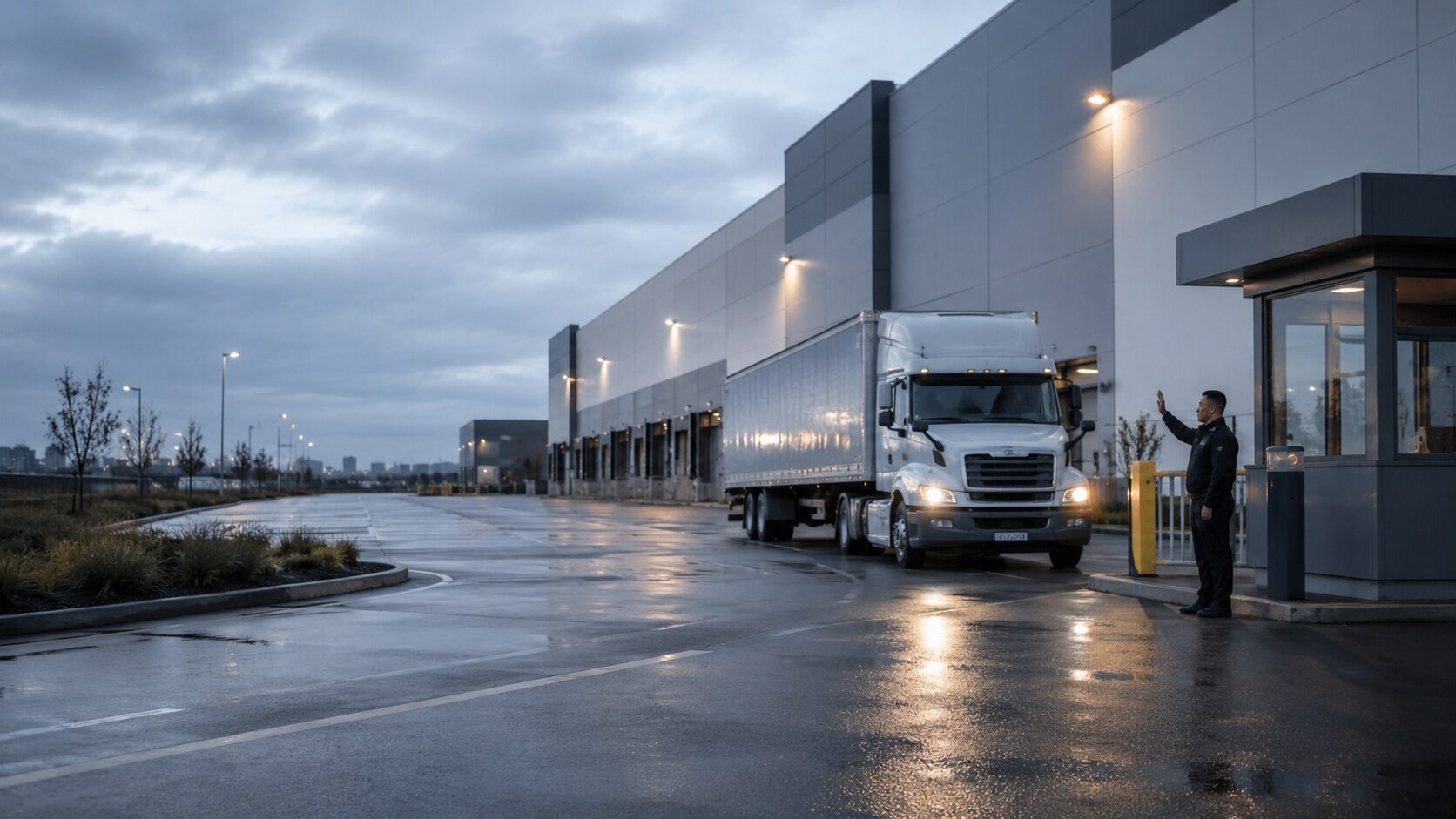
Operations managers, third-party logistics operators, and industrial landlords hire Capitol Shield Security for warehouse security across Northern Virginia and suburban Maryland. We cover docks, employee entrances, perimeters, and equipment areas, and we document every check. Call (240) 957-0356 or ask us to price coverage for your facility.
Warehouse loss is rarely dramatic. It is a pallet that leaves on a truck it was not supposed to be on, a case count that never reconciles, a rear man door that has been propped for the smoke break for two years, and a fence line nobody has walked since the building was leased.
The industrial corridors in this region run along I-95 south through Springfield and Lorton, up the Route 1 spine through Hyattsville and Beltsville, and across the Landover side of Prince George's County. Those are drivable, dispersed, fenced properties, which shapes both what goes wrong and what coverage is worth buying.
Where the Building Is Actually Open
Every warehouse has more openings than its floor plan suggests, and most of them are open more than management thinks.
Dock doors are the obvious ones and they stand open for hours at a time during operating shifts. Man doors beside the docks are the quieter problem: propped for airflow, for a break, or because the latch has been failing since spring. Employee entrances, driver entrances, and office doors on the front of the building each have their own habits.
Then there is the roof, which is a real entry route on single-story industrial buildings, and the yard gate that was left open because a late truck was expected and nobody went back out.
We walk all of it before quoting, and the post orders name specific doors rather than referring to the perimeter. An officer told to check the perimeter checks what they can see. An officer told to check the northeast man door beside dock eleven checks that door.
Security officers are not a replacement for law enforcement, fire personnel, or emergency medical services.
Operating Hours: Docks, Drivers, and the People Inside
During a running shift the exposure is people rather than the building. Drivers waiting on a load, temporary staff on their first day, contractors, and a steady stream of unfamiliar faces in a facility where almost nobody is badged.
Officer coverage on an operating shift is mostly access verification and traffic. Confirming drivers are expected before they enter the yard, keeping the driver area separate from the working floor, verifying contractors against a work order, and watching the doors that are supposed to stay closed.
Employee entrances at shift change are worth specific attention. It is the one time of day when large numbers of people move through the same door in both directions, and it is when bags and vehicles move with them. An officer present at shift change changes what leaves the building, without anybody being searched.
Cold storage adds an operational wrinkle: doors that must stay sealed, tighter product controls, and a facility where a propped door is a product loss as well as a security one.
After Hours: The Building Nobody Is Watching
A closed warehouse is a large, dark, mostly unmonitored building with high-value contents and long sightlines that nobody is standing in. Alarm systems cover doors; they do not cover the fence line, the yard, or the trailers parked against the building.
Overnight coverage is a route, not a chair. The fence line walked rather than driven. Every door and gate checked and confirmed. Trailers and containers checked for seals and for anyone working on one. Equipment and fuel checked. Lighting outages noted, because a dark corner on an industrial parcel is where the next problem starts.
Roof access points and utility yards get checked on the same interval. So does anything staged outside, which on many industrial properties is where the highest-value items sit precisely because they did not fit inside.
Where a facility does not justify a full overnight post, mobile patrol services covering several industrial properties on randomized timing is the standard answer, and in these corridors it works well because the geography is built for it.
Inventory Loss, and What Security Can Honestly Address
It is worth being precise about what an officer changes and what they do not.
An officer changes opportunistic loss substantially: things that walk out because nobody was looking, doors that stay closed because somebody checks them, and outsiders who do not enter because there is a uniform in the yard. Presence at shift change and at the docks measurably shifts that.
An officer does not solve inventory shrink driven by process. If cases are going missing between receiving and put-away, or if counts are failing at the same SKU every cycle, that is a systems and supervision problem, and no amount of guard hours fixes it. We will say so rather than take an assignment written to solve the wrong problem.
The useful middle ground is documentation. An officer who logs which trailers were on the property, when the yard gate was opened, and who entered outside operating hours gives your operations team something concrete to reconcile against, which is often what turns a suspicion into a finding.
Fire Watch, Impairments, and Racked Storage
High-piled and racked storage carries specific fire protection requirements, which means an impairment in a warehouse is a bigger deal than in an office building of the same size. In-rack sprinklers taken out of service for a rack reconfiguration, a system drained for a tenant fit-out, or a damaged main all put the building on a clock.
Fire watch security in a warehouse is a physically demanding route: long runs, multiple levels of rack, and a requirement to actually look down aisles rather than along them. The log the fire marshal reviews has to reflect a route that covered the storage, not a lap of the office.
We staff those watches, and we can run them alongside existing coverage without a separate mobilization.
Verified Checks, Not a Signature on a Sheet
The traditional warehouse guard tour is a clipboard and a signature, and it is worth exactly what it costs. Ours is a timestamped, GPS-verified record: each checkpoint marked as the officer reaches it, photographs of anything that needs a second look, and a report closed before the shift ends.
For an operations manager that record answers questions that come up days later. Whether the northeast door was secured at close on the night a pallet is unaccounted for. When the yard gate was opened over a weekend. How many trailers were on the property Sunday night.
It also protects the facility with its insurer. A building that can produce dated, verified checks for the months before an incident is in a different conversation with an adjuster than a building whose evidence is a stack of initialed tour sheets.
How We Cover Industrial Property
- Post orders that name specific doors, gates, and staging areas rather than the perimeter
- Coverage at shift change, when the most people and property move through one door
- Overnight routes that walk the fence line, trailers, and outside staging, not just the building
- Honest scope: we will tell you when shrink is a process problem rather than a guard problem
- Fire watch for racked and high-piled storage impairments, run alongside existing coverage
- Portfolio routing where several facilities sit within a few miles of each other
- Timestamped, GPS-verified checks instead of an initialed tour sheet
Warehouse Coverage Questions
Partly, and it is worth being specific about which part. Opportunistic loss, property leaving because nobody was watching, doors staying open because nobody checked, outsiders entering an unwatched yard, responds well to presence at the docks and at shift change. Shrink driven by process, where counts fail between receiving and put-away, is a systems and supervision issue, and guard hours will not fix it. We would rather tell you that than bill for the wrong solution.
Overnight is the baseline, because that is when the building is dark and nobody is in it. Daytime coverage earns its place at facilities with heavy driver traffic, large temporary or seasonal staffing, or a shift change that moves a lot of people through one door at once. Many facilities run a full overnight route with a shorter daytime post covering shift change and the busiest dock hours.
In these industrial corridors, often yes. Properties along the I-95 south corridor and across the Landover and Beltsville side are dispersed and drivable, which is exactly the geography a route is built for. One officer can run several facilities in a shift on timing that does not repeat, with every stop logged. Where a single building needs continuous presence, we will tell you a route is not enough.
Related Security Services
Distribution Yard Security
Truck gate control, trailer checks, and yard patrols for distribution and logistics sites.
ExploreMobile Patrol and Alarm Response
Marked-vehicle patrol routes and after-hours alarm response across multiple sites.
ExploreFire Watch Security
Code-mandated coverage when a fire alarm or sprinkler system is out of service.
ExploreWarehouse Security Across the DC Metro Area
We provide warehouse security throughout the Washington DC Metro Area. Explore coverage by city.
Tysons
Warehouse security and full guard coverage in Tysons.
View locationArlington
Warehouse security and full guard coverage in Arlington.
View locationAlexandria
Warehouse security and full guard coverage in Alexandria.
View locationGreenbelt
Warehouse security and full guard coverage in Greenbelt.
View locationRockville
Warehouse security and full guard coverage in Rockville.
View locationSilver Spring
Warehouse security and full guard coverage in Silver Spring.
View locationWe are hiring licensed security guards across the DC metro area for armed, unarmed, and fire watch posts.
Price Coverage for Your Facility
Tell us about your property and a dedicated security coordinator will recommend the right coverage.