
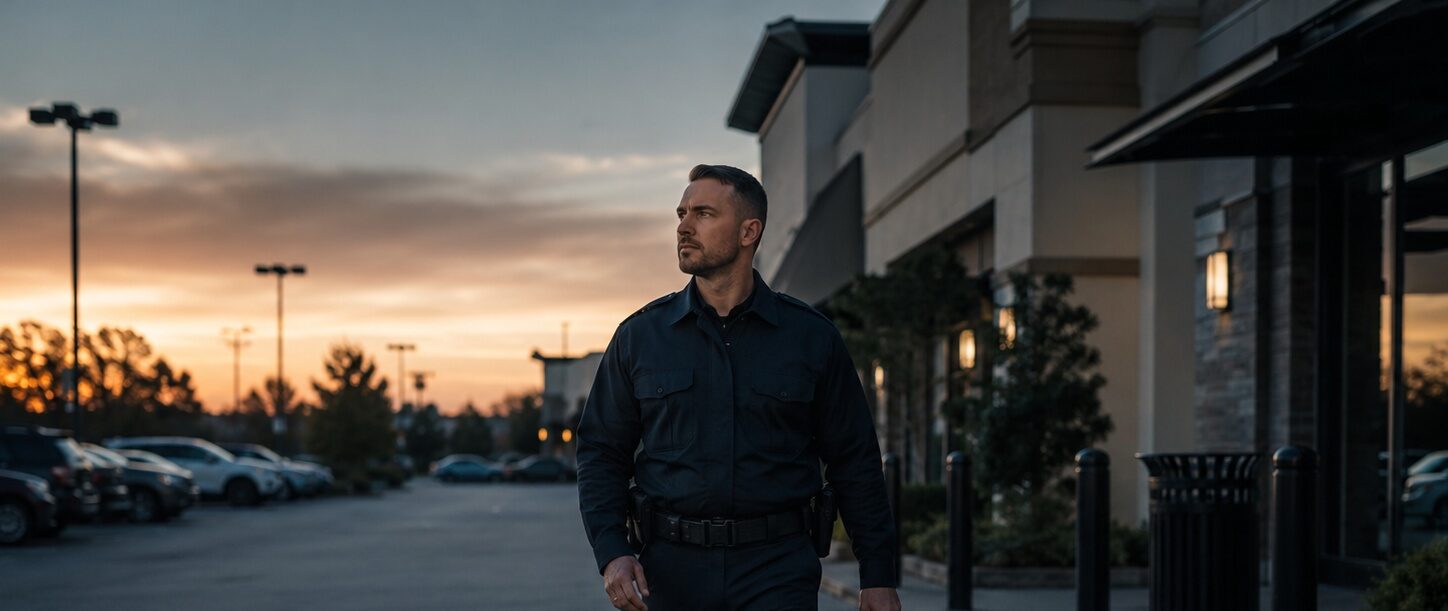
Center managers, retail operators, and mixed-use owners hire Capitol Shield Security for commercial security guard services across Northern Virginia and suburban Maryland. We staff floor presence, closing support, and structured parking coverage, and we document every shift. Call (240) 957-0356 or ask us to price coverage for your center.
Retail is the broadest security market in the region and the most saturated, which means the pitch you have heard before is probably the same one you will hear again. The thing worth asking any operator is narrower: what will your officers actually do at eight on a Saturday night, and what will you be able to read about it on Monday.
Commercial property does not have one security problem. A grocery-anchored center, a lifestyle center with restaurants, a strip of small tenants, and a mixed-use block with residents above the retail behave differently and fail differently, and the coverage should not be identical.
The Hours That Actually Matter
Nearly every retail property concentrates its exposure into a small number of hours, and coverage spread evenly across a day is coverage wasted. Weekday afternoons are usually quiet. The pressure sits at opening, at closing, and across Friday and Saturday evenings when a center runs a week's activity through a few hours.
Closing is the sharpest of them. Tenants close at different times, staff leave in ones and twos into a lot that is emptying, cash moves from registers to a safe or to a bank, and the last person out of a small shop is often alone. A center with an officer visible during that window is a materially different place from one without.
Opening carries its own smaller version: an employee arriving before dawn at a dark rear entrance, a delivery arriving before anyone is inside, a service corridor that was empty overnight.
We build post orders from your center's actual pattern. If your incident history says the problem is Thursday through Saturday from seven until close, that is what we staff, and we will say so rather than sell a fuller schedule.
Floor Presence, Loss, and the Line We Do Not Cross
An officer on a retail floor is there to be seen, to help, and to write things down. Visible presence at an entrance changes what an opportunistic shoplifter decides to attempt, and it is by far the largest share of the value.
Organized retail theft is a different problem and it needs saying plainly. Groups working a corridor of stores are planning, not improvising, and no single unarmed officer stops that in the moment. What an officer can usefully do is notice a pattern early, document vehicles and descriptions, and get that to center management and to the police agency with jurisdiction quickly enough to matter.
The line we do not cross is apprehension. Our officers observe and report; they do not detain, pursue into a parking lot, or put hands on a customer over merchandise. That is a policy, not a limitation we are apologizing for, and any operator promising you otherwise is describing a liability you will end up owning.
Security officers are not a replacement for law enforcement, fire personnel, or emergency medical services.
Parking Is Where the Losses Are
Most recurring loss at a retail property does not happen inside a store. It happens in the lot or the structure: vehicle break-ins, catalytic converter theft, cart-related damage, confrontations spilling out of a restaurant late on a weekend night, and people sleeping in vehicles in the far corners of a lot nobody drives through.
Parking lot security is also the part of the property that decides whether people come back. A lot that feels watched at two in the afternoon and abandoned at ten at night is doing half the job, and the half it is failing is the one customers notice.
We cover structures and surface lots on foot on randomized intervals during peak evening hours rather than posting an officer at an entrance and calling the property covered. On a large surface lot that means the far edges and the rows nearest the tree line, which is where vehicles get worked and where a stationary post never looks.
Tenants, Management, and Who the Officer Answers To
An officer who works around center management instead of with it is a wasted post. We coordinate with your management office so the officer knows which stores close latest, where the service corridors run, which tenants have had problems, and who to call for what.
Tenants matter too, in a specific way. Store managers know their own patterns better than any incident report does, and an officer who has introduced themselves to the ten businesses on a corridor gets told about a developing issue days before it reaches the management office. We treat that as part of the job rather than as chatting.
Where a center has a mixed-use component, the residential side has different expectations and different hours. Residents want quiet and consistency; retail wants presence at peak. The post orders have to hold both, and where the volume justifies it apartment building security on the residential side is often a separate assignment rather than a stretched one.
Fitting Coverage to the Property
A small strip center with six tenants rarely needs a dedicated officer. What it usually needs is a closing check and a couple of overnight passes, which is mobile patrol services rather than a post, at a fraction of the cost.
A grocery-anchored center with extended hours usually needs a post at peak and patrol coverage otherwise. A lifestyle center with restaurants and a cinema needs its heaviest coverage at the hours everything else is closing. A center with a cash office or high-value tenants may want armed security guards at that specific point while the rest of the property runs unarmed.
Whatever the shape, we would rather size it to the property than sell a standard package. If we think you are buying more hours than your exposure justifies, we will tell you before the contract, which is a cheaper time to hear it.
What Management Reads on Monday
Every shift produces a record: checkpoints marked in real time, photographs where they add something, and incident reports closed before the officer leaves rather than written up later from memory. GPS verification confirms the officer reached each logged point.
For a center manager that record answers the questions that actually arrive. Whether the structure was walked the night a vehicle was broken into. Whether the rear corridor was checked at close on the days a tenant is reporting problems. Whether the run of complaints from one store is a pattern or two incidents that felt like more.
It also gives you something to hand a tenant. A retailer asking what the center is doing about a parking problem is a much shorter conversation when the answer is a dated log of passes rather than an assurance.
How We Cover Commercial and Retail Property
- Hours built from your incident pattern, not spread evenly across a day
- Closing support for tenants and staff leaving into an emptying lot
- Structures and lots walked on randomized intervals during peak evening hours
- A clear observe-and-report policy: no apprehension, no pursuit, no hands on customers
- Direct coordination with center management and with individual store managers
- Honest sizing, including telling you when a route beats a post
- Timestamped, GPS-verified records you can put in front of a tenant
Commercial and Retail Coverage Questions
No, and that is deliberate. Our officers observe, document, and report to center management and to the police agency with jurisdiction. They do not detain, pursue, or make physical contact over merchandise. The deterrent value of a visible uniform is real and it is most of what you are buying; apprehension is a liability that lands on the property owner, and we will not take it on or encourage you to.
Outside, most of the time. Recurring loss at retail property concentrates in the parking areas rather than on the sales floor, and that is where the presence changes behavior. Interior coverage earns its place where a specific tenant mix, a cash office, or a corridor of small shops has a documented problem, and in that case the post orders name the locations rather than describing a general presence.
It depends on the layout and the hours. One officer can hold a compact center with a single lot during peak evening hours. A center with two structures, a rear service corridor, and tenants closing across a three-hour spread is more than one person can cover at the times it matters. We would rather tell you that a second officer is needed on Friday and Saturday only than staff the whole week thin.
Related Security Services
Parking Lot and Garage Security
Garage and surface-lot patrols, vehicle break-in deterrence, and escort support.
ExploreOffice Building Security
Lobby and front-desk posts, visitor management, and after-hours access control.
ExploreMobile Patrol and Alarm Response
Marked-vehicle patrol routes and after-hours alarm response across multiple sites.
ExploreCommercial and Retail Security Across the DC Metro Area
We provide commercial and retail security throughout the Washington DC Metro Area. Explore coverage by city.
Tysons
Commercial and Retail security and full guard coverage in Tysons.
View locationArlington
Commercial and Retail security and full guard coverage in Arlington.
View locationAlexandria
Commercial and Retail security and full guard coverage in Alexandria.
View locationGreenbelt
Commercial and Retail security and full guard coverage in Greenbelt.
View locationRockville
Commercial and Retail security and full guard coverage in Rockville.
View locationSilver Spring
Commercial and Retail security and full guard coverage in Silver Spring.
View locationWe are hiring licensed security guards across the DC metro area for armed, unarmed, and fire watch posts.
Price Coverage for Your Center
Tell us about your property and a dedicated security coordinator will recommend the right coverage.