
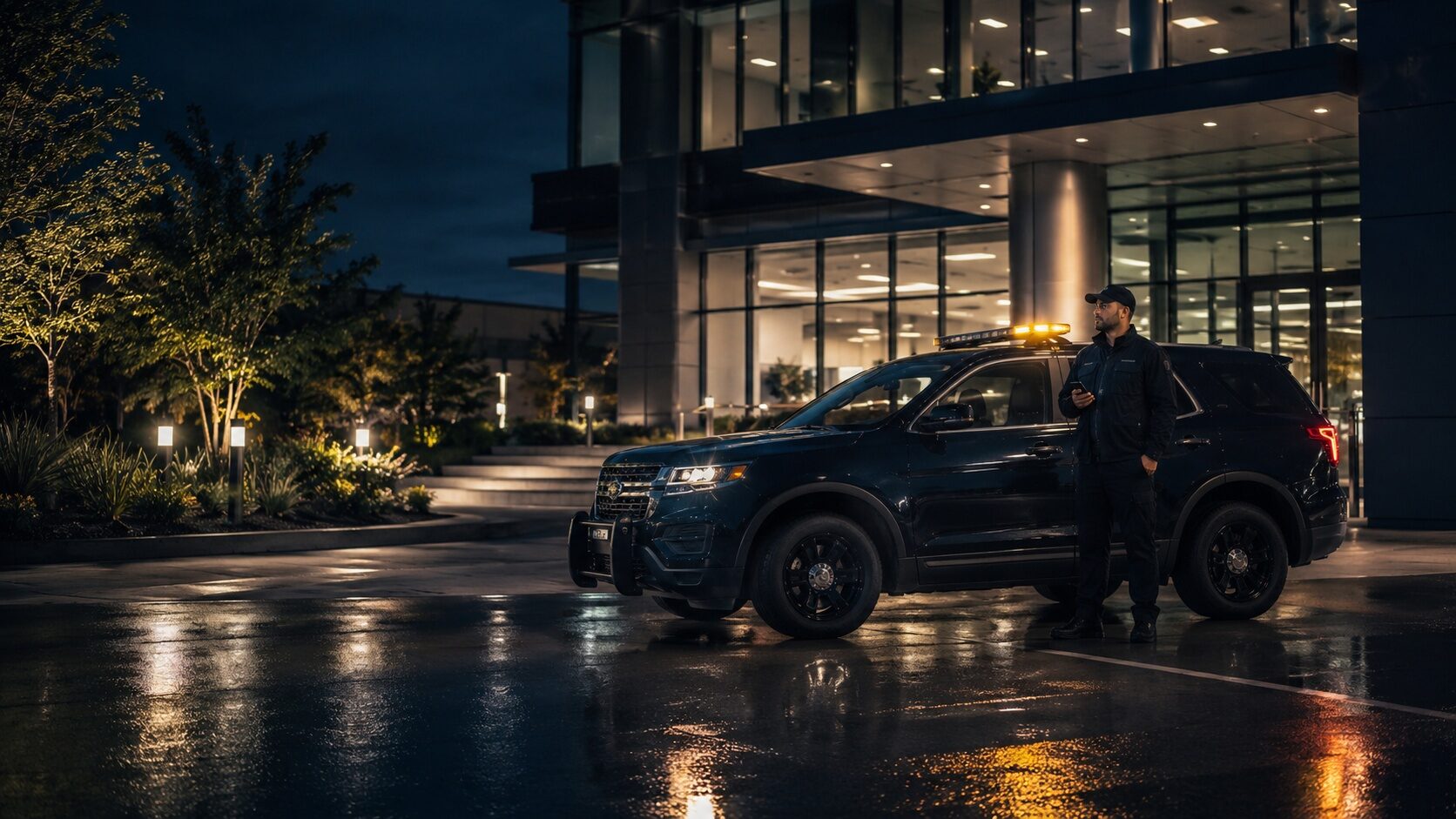
Property managers, HOA boards, and small business owners hire Capitol Shield Security for mobile patrol services when a site needs documented presence but cannot justify a guard standing on it all night. We run marked-vehicle routes and after-hours alarm response across Northern Virginia and suburban Maryland. Call (240) 957-0356 or ask us to price a route for your properties.
A patrol route is the cheapest real security most properties will ever buy. The economics are simple: one officer covers several accounts per shift instead of one, so each account pays a fraction of a dedicated post and still gets a marked vehicle in its lot, a walk of its perimeter, and a written record that it happened.
The catch is that a badly built route is worse than nothing. Same time every night, same direction, same three doors checked, and within two weeks anyone paying attention knows exactly when your property is unwatched. Most of the work in this service is in the route design, not the driving.
What a Patrol Route Actually Covers
Each stop on a route runs a checklist written for that property, not a generic sweep. Exterior doors and gates checked and confirmed secured. Lighting outages noted with a location. Dumpster corrals, loading areas, and service corridors walked rather than driven past. Parking areas covered on foot where the layout allows it, because a slow drive-through and a walk find different things.
Then there is whatever the account has specifically flagged. A property that has been losing catalytic converters gets its lot walked on every pass. A community fighting after-hours pool use gets the amenity area checked against posted hours. A vacant suite mid-renovation gets its door and its lockbox verified. Those items go into the post orders and they are what the officer is measured on.
Every stop is logged with a time and a location as it happens. If a door is found unsecured, the officer secures it where that is safe to do and documents it either way, and your contact hears about it that night rather than reading it in a weekly summary.
Security officers are not a replacement for law enforcement, fire personnel, or emergency medical services.
Where Routes Work in This Region, and Where They Do Not
Patrol suitability is a function of geography, and the spread across this region is real. Sprawling suburban markets with many separate small sites are ideal: dispersed office parks, HOA-managed communities, warehouse and flex space, retail strips, and construction sites sitting on their own parcels with their own parking. An officer can cover a lot of ground in a shift because the ground is drivable.
Dense urban cores are the opposite. Where parking is hostile, where a building's only approach is a garage entrance on a one-way street, and where the officer would spend more of the shift finding somewhere to leave the vehicle than checking the property, a route stops being efficient and quietly becomes expensive. We will tell you that rather than sell you a route that cannot keep its own schedule.
If you have properties in both kinds of geography, the honest answer is usually a mixed program: routes where the ground supports them, static posts where it does not. We would rather price that accurately than average it.
Alarm Response, and the Limits of It
After-hours alarm response puts an officer at your property when a monitoring center trips, which is useful mainly because most alarms are not burglaries. Doors that did not latch, HVAC movement, a cleaning crew off schedule, a delivery driver who found an unlocked door. Somebody has to go look, and it does not need to be you at two in the morning.
Our officer arrives, walks the perimeter, checks the point that tripped, looks for signs of forced entry, and reports what was found with photographs. Where there is evidence of a crime, the officer holds a safe position and hands it to the police agency with jurisdiction rather than clearing the building alone.
Two limits worth stating plainly. Our officers are not a monitoring service and do not replace your alarm company or your keyholder obligations, and no security firm can promise an outside agency's response time. What we can promise is that someone competent looks at your property and writes down what they saw.
Building a Route That Does Not Become Predictable
Randomized timing is the whole point, and it takes actual effort to maintain. Stops are sequenced differently across a week, arrival windows move rather than sitting on the hour, and the direction of approach changes. A route with four stops has more usable orderings than most operators bother to use.
Officer consistency pulls the other way, and both matter. A recognizable officer who has run your property for months knows which car belongs in that space, which resident walks a dog at eleven, and which contractor is supposed to be in the building on a Saturday. That familiarity is where most real catches come from. Timing should be unpredictable; the person should not be.
We also read the route back to you periodically. If three months of logs show the same lighting outage reported eleven times, that is a maintenance item nobody actioned, and it belongs in a conversation rather than in a log.
When a Route Should Become a Post
Sometimes a route is not enough, and we would rather say so than keep billing one. If incidents are clustering inside a predictable window, if the property has a continuous access-control need, or if the exposure is a lobby or a gate rather than a perimeter, a stop every few hours does not address it.
The good news is that converting is cheap in effort. A property that has been on a route for months has post orders already written from real observations rather than from a single walkthrough, so a static post starts with months of ground truth. That applies whether the answer is apartment building security on a residential property, warehouse security on an industrial one, or a partial-shift post covering only the hours the exposure actually sits in.
Coverage may be available within one hour depending on location, guard availability, and assignment requirements, which matters when a route turns up something that needs a body on site tonight rather than next week.
Every Stop, Logged
A patrol route you cannot verify is a patrol route you are taking on faith. Our officers mark each checkpoint in real time as they reach it, add photographs where they help, and file the shift report before going off duty rather than at the end of the week.
GPS verification means a checkpoint on the report is one the officer physically reached, which is the difference between a log and a claim. For a route, that is not a nicety: a route's entire value proposition is that stops actually happened at the times the record says.
What you do with that record is where it pays. A board asking whether the lot was covered the night a car was broken into has an answer with a timestamp. A manager building a case that a lighting problem is chronic has eleven dated entries instead of a memory. And a field supervisor reviewing routes catches a drifting schedule before a client notices it.
What a Capitol Shield Route Gives You
- Marked vehicle and a recognizable officer, with arrival times that do not repeat
- A per-property checklist written from your actual complaints, not a template
- Every stop logged with a time, a location, and GPS verification
- Exceptions reported the same night, not in a weekly digest
- Honest pricing on geography: we will say when a route is the wrong tool
- A clean path to a static post, with post orders already written from real observations
- After-hours alarm response with photographs of what was found
Mobile Patrol Questions
It depends entirely on drive time and how long each stop takes. A cluster of small suburban sites a few minutes apart supports a fuller route than the same number of properties spread across two counties, and a stop that requires a foot patrol of a structure takes far longer than a perimeter check. We build the route against real drive times and tell you how many passes each property gets per shift, so you are buying a known number of visits rather than a vague promise of coverage.
That is what we aim for, because familiarity is where most real catches come from. An officer who has run your site for months notices the vehicle that does not belong long before a stranger would. Schedules, time off, and turnover mean it will not be one person forever, so post orders carry enough detail that a covering officer works to the same standard rather than improvising.
For many properties, yes. For some, no, and we will tell you which one you are. If incidents cluster in a predictable window, if you need continuous access control, or if the exposure is a staffed lobby or gate rather than a perimeter, a stop every few hours does not close it. In that case we would rather move you to a post, or to a short post plus a later patrol stop, than keep selling passes that do not fit the problem.
Related Security Services
Fire Watch Security
Code-mandated coverage when a fire alarm or sprinkler system is out of service.
ExploreApartment and Multifamily Security
Apartment communities, condo associations, and HOAs with patrol and parking enforcement support.
ExploreParking Lot and Garage Security
Garage and surface-lot patrols, vehicle break-in deterrence, and escort support.
ExploreMobile Patrol and Alarm Response Across the DC Metro Area
We provide mobile patrol and alarm response throughout the Washington DC Metro Area. Explore coverage by city.
Tysons
Mobile Patrol security and full guard coverage in Tysons.
View locationArlington
Mobile Patrol security and full guard coverage in Arlington.
View locationAlexandria
Mobile Patrol security and full guard coverage in Alexandria.
View locationGreenbelt
Mobile Patrol security and full guard coverage in Greenbelt.
View locationRockville
Mobile Patrol security and full guard coverage in Rockville.
View locationSilver Spring
Mobile Patrol security and full guard coverage in Silver Spring.
View locationWe are hiring licensed security guards across the DC metro area for armed, unarmed, and fire watch posts.
Price a Patrol Route for Your Properties
Tell us about your property and a dedicated security coordinator will recommend the right coverage.