
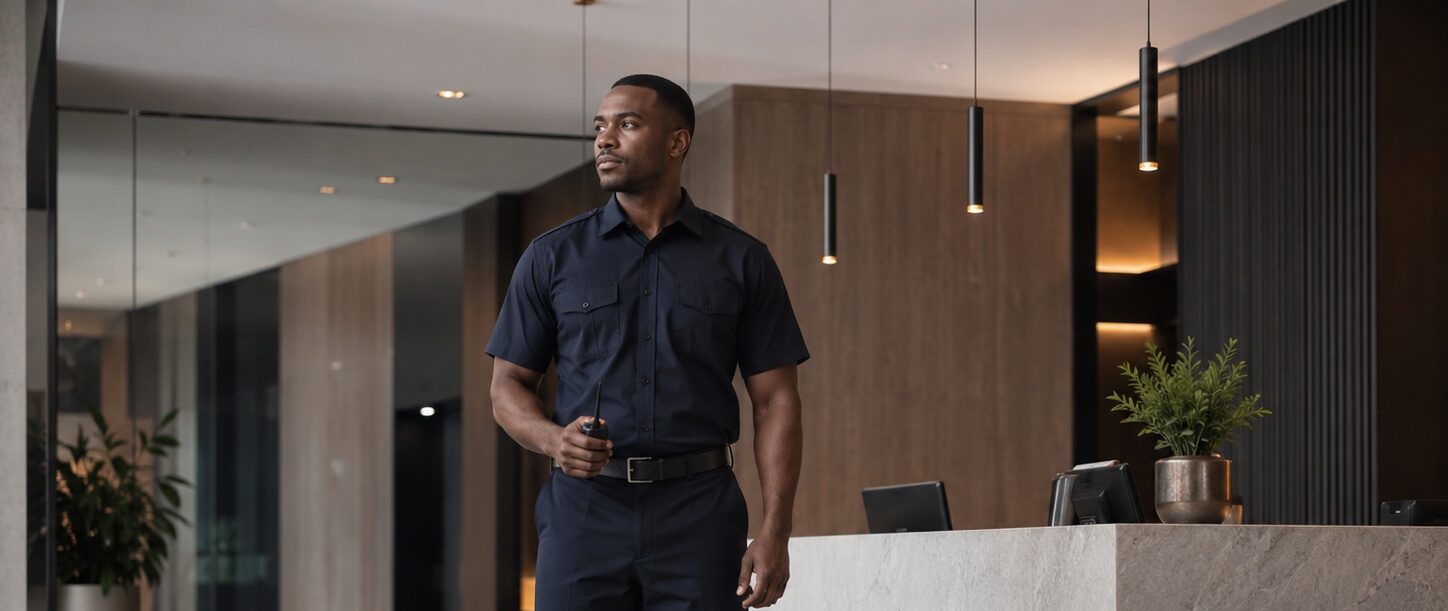
Building engineers, property managers, and ownership groups hire Capitol Shield Security for office building security across Northern Virginia and suburban Maryland. We staff lobby desks, control vertical access, supervise docks and freight, and cover garages, all against written orders. Call (240) 957-0356 or ask us to price a post for your building.
An office building is one of the few property types where the security program is genuinely part of the tenant experience. The officer at the desk is the first person a visitor meets and the last person a tenant sees leaving at eight at night, and both of those interactions are the building's brand as much as the lobby finishes are.
The other half of the job is invisible to tenants and is where the actual risk sits: who reached which floor, which contractor was in a mechanical space, what came in through the dock, and whether the garage was walked on the nights it should have been.
The Lobby Post Is a Judgment Job
A lobby officer manages a stream of people who each believe they belong there. Tenants who forgot a badge. Visitors with a name and no appointment. Couriers who want a signature and a shortcut. Vendors with a work order for a suite that has moved. Job candidates. Someone with no reason to be there at all.
Getting that right is judgment, not procedure. The officer has to verify without being adversarial, keep a line moving at nine in the morning, and stay just as careful at four in the afternoon when the lobby is empty and nobody is watching. Consistency at the low-traffic hours is where lobby posts usually fail.
The other lobby function is de-escalation. Office lobbies attract a share of walk-in situations that have nothing to do with the tenants, and the correct handling is calm, distance, and a call to the police agency with jurisdiction when it is warranted, not an argument in front of a tenant's clients.
Security officers are not a replacement for law enforcement, fire personnel, or emergency medical services.
Vertical Access Control
In a multi-tenant building the meaningful boundary is not the front door, it is the elevator bank. Anyone can reach a lobby; the question is who reaches the fourteenth floor.
Access control here is mostly about the failure modes rather than the system. Tailgating into a turnstile behind someone with a badge. A visitor issued a badge with more access than the visit requires. A stair door propped for a delivery and left. A contractor moving between floors on a badge issued for one suite. A departed employee whose credential was never revoked because nobody told the building.
An officer at the console who understands the access system is worth more than the system alone, because the system will do exactly what it is configured to do and none of the above is a configuration problem. We ask for a briefing on how your credentials and visitor management actually work, and we write the escalation into the post orders rather than leaving it to be figured out live.
Mechanical spaces, roof access, and electrical rooms get their own line. A contractor in a mechanical room at eleven at night is either scheduled or is a serious problem, and the officer should be able to tell which within one phone call.
The Loading Dock and Freight
Docks are where the fewest eyes and the most movement coincide. Deliveries, tenant moves, furniture, waste removal, and contractors staging material all pass through, usually with a door standing open and a corridor leading straight into the building's back of house.
Dock supervision is not glamorous and it prevents a specific list of problems: unbadged people walking in behind a delivery, material leaving that was not supposed to, a freight elevator locked out for a move nobody scheduled, and a dock door left open after the last truck. An officer verifies what is arriving, keeps the door under control between movements, and logs freight elevator use during tenant moves.
Tenant moves deserve their own mention because they are the highest-loss event most office buildings see. A move brings unfamiliar crews, propped doors, a freight car running for hours, and a lot of property in transit. Buildings that staff a move specifically almost never regret it.
Garages, After Hours, and the Walk to the Car
For most office tenants, the security question that actually gets raised in a renewal negotiation is the garage at night. A structure attached to an office building empties predictably: full at ten in the morning, nearly empty at seven at night, and whoever is still there is walking to an isolated car on a level with poor sightlines.
Two things address it and both are cheap. Foot patrols of the structure weighted to the evening hours rather than distributed evenly, and an escort available on request from the lobby desk. Escorts get used far more than owners expect once tenants know they exist, which is the point.
Structured parking is also where a building's recurring property loss concentrates, so parking lot security is not a separate service so much as an unavoidable part of an office post. We route patrols through levels on intervals that do not repeat and log each pass with its level and time.
Sizing the Post Honestly
Not every building needs twenty-four hours. A single-tenant suburban building with badge access and no lobby desk may need nothing more than mobile patrol services covering evening and overnight checks. A multi-tenant building with a staffed lobby usually needs the desk covered through business hours and a patrol overnight, not two full posts.
Where a building does need continuous coverage, the honest version costs more than most first quotes suggest, because continuous means relief for breaks and a plan for callouts rather than a schedule that assumes nobody is ever sick.
For short-notice needs, a system impairment, a sudden vacancy, or a tenant situation, coverage may be available within one hour depending on location, guard availability, and assignment requirements.
A Log a Building Engineer Can Audit
Building engineers are the most skeptical readers of a security report, and correctly so, because they know what a real tour of their building takes and roughly how long it should have taken.
Our officers mark checkpoints in the moment, photograph conditions worth a second look, and close incident reports before going off shift. GPS verification means a checkpoint on the report is one the officer physically stood at, so a tour that shows every level of a garage was a tour that visited every level of the garage.
That record does routine work: answering a tenant asking whether a floor was checked, giving ownership a defensible account during a month with an incident, and letting a supervisor see a post drifting before a tenant complaint makes it visible. It also catches building problems, since a log with the same stair door reported unlatched eleven times is a work order waiting to be written.
How We Staff an Office Building
- Lobby officers screened for judgment and de-escalation, not just presence
- Access control written around the real failure modes: tailgating, propped doors, stale credentials
- Dock and freight supervision, including dedicated coverage for tenant moves
- Garage foot patrols weighted to the evening, plus escorts on request from the desk
- Post orders built after a walkthrough with your engineer, then revised as the building teaches us things
- Honest sizing, including saying when a patrol route beats a staffed desk
- Timestamped, GPS-verified tour records an engineer can audit
Office Building Coverage Questions
It comes down to whether the building has a public front door and a visitor stream. A multi-tenant building that receives visitors, couriers, and contractors all day needs a person at the desk during business hours, because that traffic is the exposure. A single-tenant or badge-only building with no visitor flow often does better with evening and overnight patrol coverage and no desk at all. We look at the actual traffic before recommending either.
Yes. We ask for a briefing on how your credentials, visitor management, and console are configured, and we write the specifics into the post orders: who can issue a badge, what access a visitor badge carries, what happens when a credential fails, and who gets called. Officers reinforce the building's own procedure rather than substituting one of their own.
More than a normal day, and it is worth scheduling in advance. Moves bring unfamiliar crews, doors propped for hours, a freight car running continuously, and a large volume of property in transit, which is the highest-loss event most office buildings see. We typically staff a dedicated officer at the freight and dock for the duration of the move, with the regular post continuing at the lobby.
Related Security Services
Commercial and Retail Security
Shopping centers, grocery, and mixed-use retail with access control and loss prevention support.
ExploreParking Lot and Garage Security
Garage and surface-lot patrols, vehicle break-in deterrence, and escort support.
ExploreFire Watch Security
Code-mandated coverage when a fire alarm or sprinkler system is out of service.
ExploreOffice Building Security Across the DC Metro Area
We provide office building security throughout the Washington DC Metro Area. Explore coverage by city.
Tysons
Office Buildings security and full guard coverage in Tysons.
View locationArlington
Office Buildings security and full guard coverage in Arlington.
View locationAlexandria
Office Buildings security and full guard coverage in Alexandria.
View locationGreenbelt
Office Buildings security and full guard coverage in Greenbelt.
View locationRockville
Office Buildings security and full guard coverage in Rockville.
View locationSilver Spring
Office Buildings security and full guard coverage in Silver Spring.
View locationWe are hiring licensed security guards across the DC metro area for armed, unarmed, and fire watch posts.
Price an Office Building Post
Tell us about your property and a dedicated security coordinator will recommend the right coverage.