
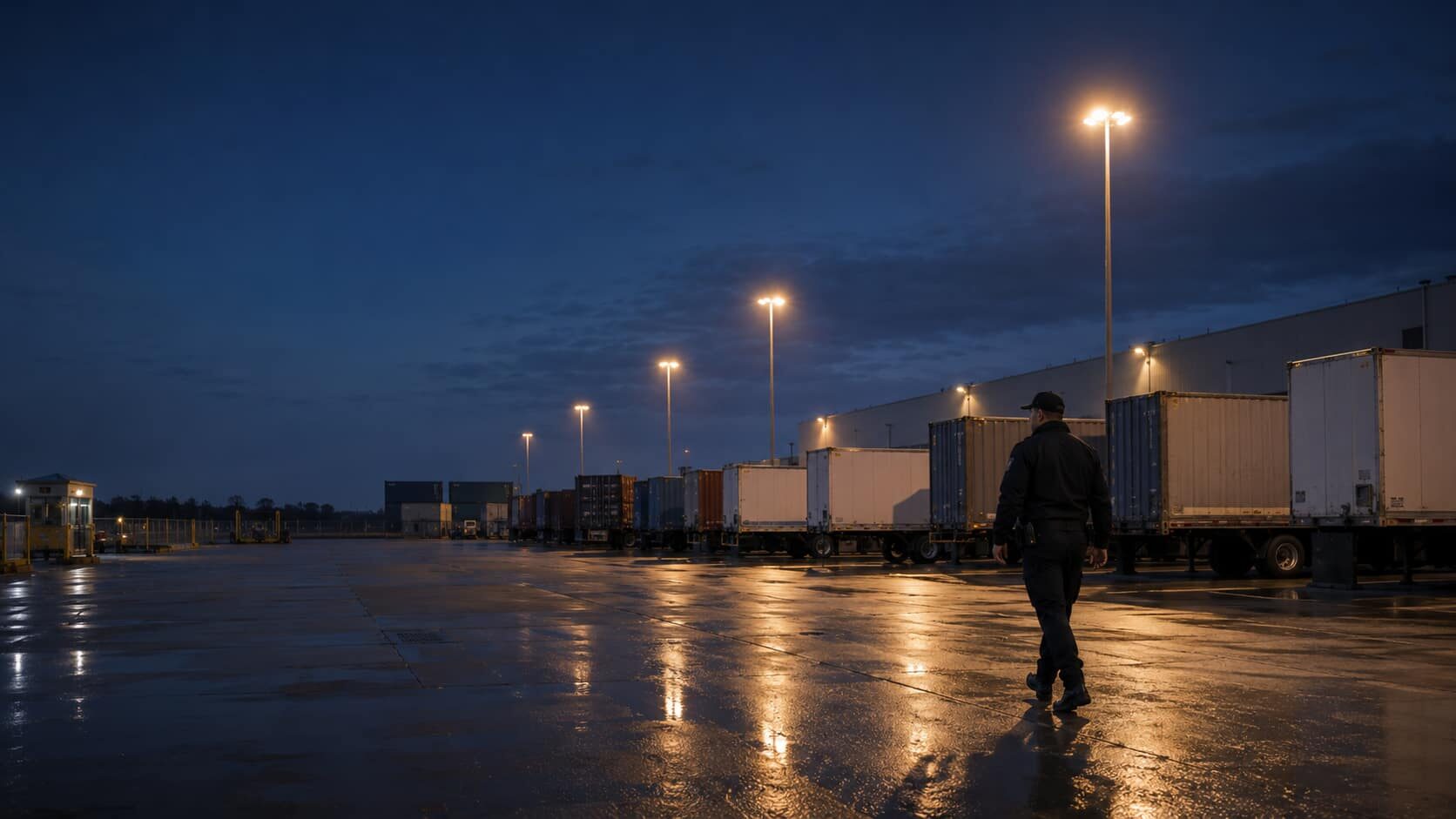
Logistics operators, yard managers, and industrial landlords hire Capitol Shield Security for distribution yard security across Northern Virginia and suburban Maryland. We staff truck gates, run yard checks, and document trailer and container movement. Call (240) 957-0356 or ask us to price gate and yard coverage.
A distribution yard is a security problem with wheels on it. The assets move, they move on somebody else's schedule, and the person driving them away is usually a stranger who was a stranger yesterday too. Almost everything that goes wrong in a yard goes wrong at the gate.
The good news is that gate work is highly proceduralized. Verify, record, and document, in that order, every time, with no exceptions made because a driver is in a hurry. Most yard loss is prevented by an officer who does the boring version of the job at two in the morning.
The Gate Is the Whole Job
An officer at a truck gate does four things on every movement: confirms the driver and carrier are expected, checks the paperwork against what the yard is expecting, records the tractor and trailer identifiers, and notes the seal.
Recording is the part that gets shortened when a line builds, and it is the part that matters. A trailer number, a seal number, a carrier, a driver name, and a time, in and out. That record is what makes a discrepancy findable a week later instead of unprovable.
Seals deserve their own line. An officer checks that a seal is present, that the number matches the paperwork, and that it is intact. An officer does not adjudicate whether a discrepancy is theft, an error, or a carrier problem. The officer documents it and escalates it, because the boundary between verify-and-document and investigate is one we hold to deliberately.
Traffic is the fourth job. A gate that backs trucks onto a public roadway creates a different problem than the one you hired for, so metering arrivals and staging drivers off the street is part of the post orders on any yard with a tight approach.
Security officers are not a replacement for law enforcement, fire personnel, or emergency medical services.
Yard Checks and Trailer Counts
Between gate movements, the officer walks the yard.
A yard check covers the fence line and the gates, the rows themselves, the seals on parked loaded trailers, empties and containers, any yard equipment and its fuel, and lighting. Long rows of trailers create excellent cover for anyone working on one, so the rows have to be walked rather than viewed from a road.
Trailer counts are the recurring deliverable. Counting the yard against your list, flagging what is present that should not be, and flagging what is missing. Where an operation runs a yard management system, our count reconciles against it; where it does not, the count becomes the record.
Counts are worth doing at a consistent point in the day so the numbers are comparable, and worth doing more often when a yard is churning. On a quiet weekend a single count may be enough. During peak season a count per shift is not excessive.
Where This Work Sits in the Region
The distribution base in this region is concentrated and it is drivable. The I-95 corridor running south through Springfield and Lorton carries warehouse, logistics, and distribution property. On the Maryland side, Landover, Lanham, and Beltsville carry the distribution and warehouse inventory inside the Beltway.
That geography matters for pricing. Yards in those corridors sit on their own parcels with their own gates and their own parking, which is what makes multi-site coverage practical. A single officer can cover more than one yard in a shift where the properties are close enough and the gate volume allows it.
It also means a yard is rarely isolated. A property with a neighbor two hundred yards away shares a fence line, shares a road, and often shares a problem, and an officer who documents a pattern gives you something concrete to take to the neighboring owner or to the county.
Data Centers and the Contracting Boundary
Data center perimeters are part of the industrial landscape here, and the question comes up often enough to answer directly.
Data center operators contract security at the enterprise level. Those relationships are negotiated centrally, run to corporate standards, and are not won through local search or a regional proposal. We say that plainly rather than implying a capability we would not be selected for.
Where we do work near that inventory is on the ordinary property around it: contractor yards, equipment laydown, construction sites for buildings under development, flex and warehouse space serving those campuses, and the fenced parcels in between. That work is real, it is local, and it is the honest scope.
Fitting Coverage to Gate Volume
Gate volume drives everything. A yard running a hundred movements a shift needs a dedicated officer at the gate and probably a second doing yard checks, because one person cannot do both without the gate becoming a bottleneck or the yard going unwalked.
A yard running a dozen movements can combine the roles, with the officer working the gate on arrivals and walking the yard between them. A yard that closes overnight often needs no gate at all, just a route.
Where a facility only needs after-hours coverage, mobile patrol services covering several yards on randomized timing is usually the right structure. Where a yard sits alongside a warehouse operation, warehouse security and the yard post are typically one assignment with one set of orders rather than two contracts.
For short-notice coverage, a peak-season surge, a sudden vacancy, or a security incident, coverage may be available within one hour depending on location, guard availability, and assignment requirements.
A Movement Log You Can Reconcile
Everything at a gate produces a record, and the record is the reason the post exists. Officers log each movement as it happens with times, identifiers, and seal condition, photograph what warrants it, and close the shift report before going off duty.
GPS verification confirms yard checks were walked rather than logged from the guard house, which on a large yard is the difference between a count and an assertion.
What that gives an operator is reconcilable data. A trailer that a carrier says was picked up Tuesday has a gate record or it does not. A seal discrepancy has a photograph and a time. A weekend with no scheduled movement has a documented set of yard checks showing the yard was quiet. Those are the specific facts that resolve claims, and they exist only if somebody wrote them down as they happened.
How We Cover a Distribution Yard
- Gate procedure applied the same way at two in the morning as at two in the afternoon
- Tractor, trailer, carrier, driver, seal, and time recorded on every movement, in and out
- A clear verify-and-document boundary: officers escalate discrepancies, they do not investigate them
- Yard rows walked rather than viewed, with seals on parked loads checked
- Trailer counts reconciled against your list or your yard management system
- Arrival metering so a queue does not back onto the public roadway
- Timestamped, GPS-verified movement and check records you can reconcile against
Yard and Gate Coverage Questions
That the carrier and driver are expected, that the paperwork matches what the yard is expecting, and that the seal is present, matches the documentation, and is intact. The tractor and trailer identifiers, the carrier, the driver, the seal number, and the time all go into the log on the way in and again on the way out. That record is what makes a discrepancy findable later rather than a matter of recollection.
The officer stops the movement, photographs the seal and the paperwork, records the discrepancy, and escalates to your yard contact immediately. What the officer does not do is decide whether it is theft, a carrier error, or a paperwork mistake, or begin questioning the driver about it. That boundary protects the evidence and it protects you, because an officer conducting an ad hoc investigation at a gate creates problems that a documented escalation does not.
Not through this kind of engagement, and we would rather say so than imply otherwise. Data center operators contract security at the enterprise level to corporate standards, and those relationships are not won locally. What we do cover near that inventory is the ordinary industrial property around it: contractor yards, laydown areas, flex and warehouse space, and construction sites for buildings under development.
Related Security Services
Warehouse Security
Overnight patrols, dock monitoring, and documented checks for warehouse and cold storage.
ExploreConstruction Site Security
Overnight and weekend coverage, gate control, and equipment and material theft prevention.
ExploreMobile Patrol and Alarm Response
Marked-vehicle patrol routes and after-hours alarm response across multiple sites.
ExploreDistribution Yard Security Across the DC Metro Area
We provide distribution yard security throughout the Washington DC Metro Area. Explore coverage by city.
Tysons
Distribution Yards security and full guard coverage in Tysons.
View locationArlington
Distribution Yards security and full guard coverage in Arlington.
View locationAlexandria
Distribution Yards security and full guard coverage in Alexandria.
View locationGreenbelt
Distribution Yards security and full guard coverage in Greenbelt.
View locationRockville
Distribution Yards security and full guard coverage in Rockville.
View locationSilver Spring
Distribution Yards security and full guard coverage in Silver Spring.
View locationWe are hiring licensed security guards across the DC metro area for armed, unarmed, and fire watch posts.
Price Gate and Yard Coverage
Tell us about your property and a dedicated security coordinator will recommend the right coverage.