
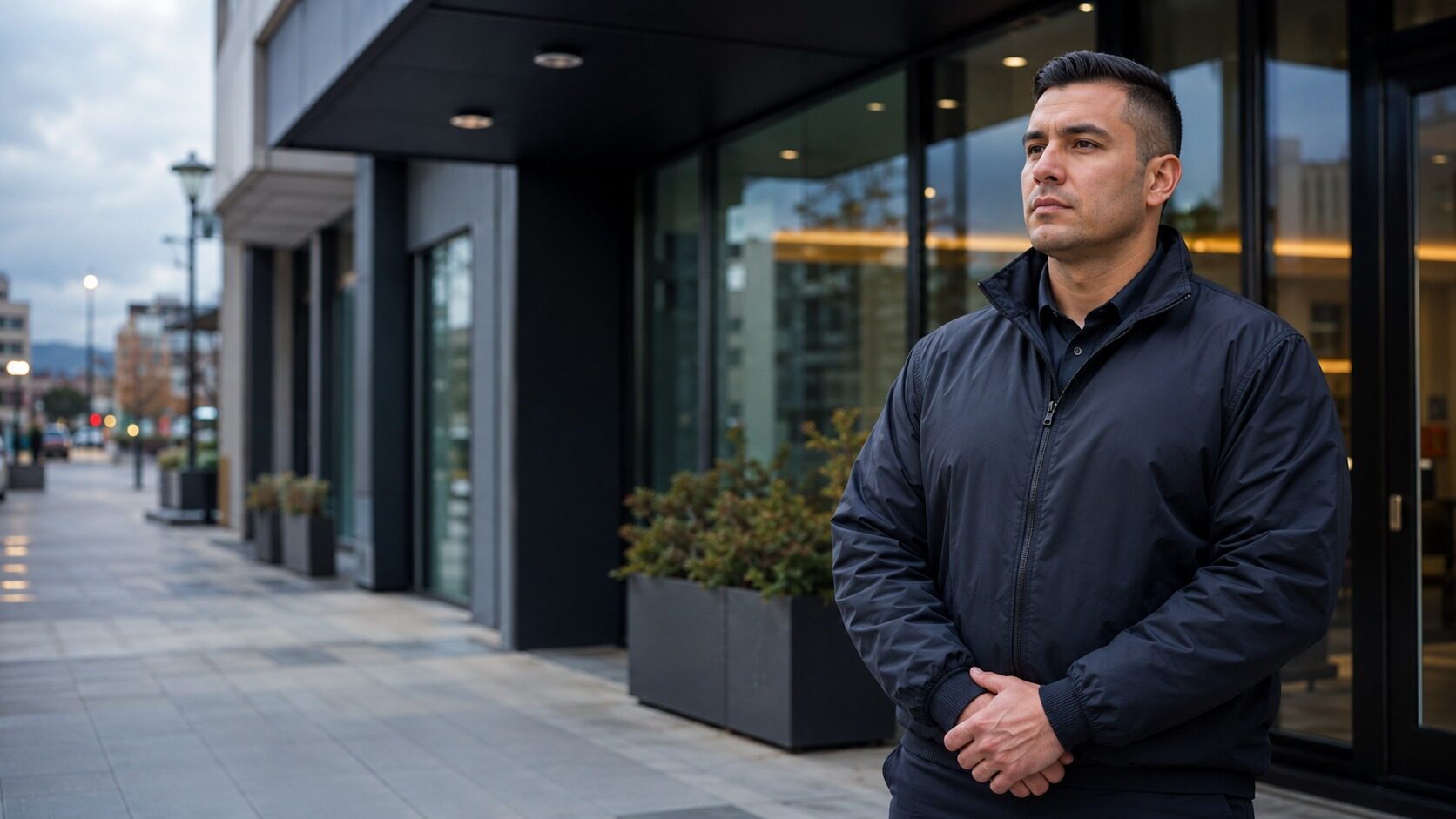
Chevy Chase retail managers, property owners, and residential building managers hire Capitol Shield Security for licensed unarmed security guards, closing and receiving coverage, patrols, and fire watch, staffed and dispatched 24/7. We cover luxury and specialty retail and the shared property around it, the receiving and service areas behind the shops, the parking serving both, and the condominium and apartment buildings nearby, backed by Maryland State Police license #26PLU-SG80123. Security coverage in Chevy Chase is coordinated through our Rockville office nine miles north, so staffing, supervision, and reporting stay local. Call (240) 957-0356 or request a free Chevy Chase security quote online.
High-value retail is a distinct security discipline and most companies staff it as though it were a shopping center with better carpet. It is not. The inventory is small, portable, and worth many times its weight, the people who steal it are frequently organized and traveling, and the customers will leave rather than shop somewhere that feels policed.
Those three facts pull against each other, and resolving them is the whole job here.
A Posture the Customer Should Barely Notice
Start with what a client here is actually buying, because it is the opposite of what security marketing usually sells.
A high-value store wants a deterrent that a professional reads instantly and a customer does not read at all. An officer standing at a door with folded arms achieves the second half of that and none of the first, because a crew casing a corridor is not deterred by posture, they are deterred by the sense that somebody is paying attention and writing things down.
So we staff these posts for presentation and observation. Officers in business attire or a soft uniform where the client prefers it, positioned where they can see an entrance and a sales floor without standing in the middle of either, moving rather than fixed, and comfortable greeting a customer as a host would. The greeting is not a courtesy, it is the technique. Being spoken to by name-adjacent staff at the door is the single most reliable thing that makes a professional leave a shop, and it costs a client nothing in atmosphere.
Armed coverage is the wrong instrument in this setting and we will say so before anybody asks. We staff armed officers where a risk profile genuinely calls for one, and a jewellery or fashion floor with a public clientele is not that profile. An armed presence changes how a shop feels in a way that no client here wants to pay for twice.
Organized Theft Is a Traveling Business
The losses that hurt in this market are not opportunistic. They are worked by groups who plan, who arrive from outside the area, who visit before they act, and who work several properties in a short window before moving on.
That has one useful implication for a property owner: what happens in your center this week probably happened in another center nearby last week, and the pattern is visible long before an individual store notices it. A description, a vehicle, a time of day, a method repeated across four addresses is information, and it is information nobody has unless somebody is recording it in a form that can be compared.
Commercial security guard services from us in that setting are property-level deterrence and documentation. Our officers observe, describe, photograph where it is lawful and appropriate to do so, and report the same shift. What they do not do is investigate, pursue, detain, or apprehend. Retail apprehension is a specialized legal exposure that belongs with a retailer's own loss prevention function and its counsel, and a vendor who offers it to a landlord is offering to carry somebody else's liability.
Where a center's tenants each hold their own loss prevention arrangements, our value is the connective tissue between them. A shared record across the common property means four stores see one pattern rather than four incidents.
Security officers are not a replacement for law enforcement, fire personnel, or emergency medical services. We maintain professional working relationships and clear communication with local police and fire agencies, and we do not guarantee their response times.
The Back of House Is Where the Goods Move
Front-of-house theft is what everybody plans for. The volume moves through the back.
High-value inventory arrives by courier and consolidator, often in unmarked packaging and often at hours when a store is thinly staffed. Returns and exchanges leave the same way. Staff entrances, stock rooms, and the service corridor behind a row of shops sit outside the field of view of every camera pointed at a sales floor, and the people using them are a rotating population of couriers, contractors, cleaners, and part-time staff whom nobody can name.
Coverage of that runs on procedure rather than presence. Deliveries checked against expected arrivals rather than accepted because somebody is holding a box. Couriers escorted to a stock room where they are not on a standing list. Staff entrances and service corridors treated as named checkpoints on a walking route rather than as doors somebody assumes are shut. Waste and recycling areas checked, because material staged for later collection is a well-worn route out of a building.
Our officers verify and document. They do not sign for consignments and they do not make judgments about discrepancies, both of which stay with the retailer.
Closing, Cash, and the Walk to the Car
The end of the trading day concentrates more risk than the rest of it combined, and it is the part most centers under-staff.
Closing is a sequence rather than a moment. Tills reconciled, safes secured, back doors locked, a shop emptied of anybody who does not work there, and then a small number of people leaving a building into a lot or a structure that has been emptying for two hours. Staff carrying a day's takings or a repair consignment on that walk is a situation that resolves itself perfectly a thousand times and once does not.
What we provide is a presence during that window rather than a shift around it. An officer visible while shops close, an escort to a vehicle for any staff member who wants one, and a verified check that doors are secured and the lot is clear at a stated time, produced as a dated record.
Parking lot security is the other half of it. Vehicle entries here concentrate on the levels furthest from a lit entrance and on the rows where staff, rather than customers, tend to park, which is where a fixed position at an entrance never reaches. We walk structures at intervals that vary, weighted to the closing window.
Residential Buildings With a Different Expectation
The residential property here is a specific buyer with a specific requirement, and it is not the same as covering a high-value store.
Many of these buildings already have a concierge or front desk, and residents value discretion above almost everything. What they want from an officer is presence at hours the desk is not staffed, garage and package room discipline, contractor and vendor traffic verified during the day, and a manner that does not make a lobby feel like a checkpoint. Apartment building security here is a supporting function alongside a building's own staff rather than a replacement for either the desk or the doorman.
Residents in this market also raise the same two things everywhere. Vendor and household traffic they did not personally arrange, and garage levels that feel wrong late at night. Both are answered by a written access procedure and a walking route rather than by a camera or a gate.
Fire Watch That Keeps a Shop Trading
NFPA 101 and NFPA 25 leave no room for judgment: past four hours with the fire alarm out inside a twenty-four hour period, or ten hours without sprinklers, a building is under a posted watch or its occupancy stops. The authority having jurisdiction issues the order.
In a retail setting the arithmetic of that is stark and it is worth naming. An impairment on a trading day does not merely inconvenience a landlord, it closes shops, and a closed store in a high-value tenancy loses more in an afternoon than a month of coverage costs. Owners here approve a watch quickly for that reason, which means the call usually arrives with the order already issued and the trading day already running.
Retail stock also complicates the circuit. A row of shops under one address has individual tenant spaces with their own keys, stock rooms nobody wants a stranger walking through unaccompanied, and a service corridor connecting the lot. Fire watch security here means the access arrangements for every tenancy on the circuit get settled before the first lap, not negotiated at the third one. One officer, a mapped route, an interval measured against a clock, the impaired system checked by name, an entry stamped at each pass, and the training to pull the alarm and call it in.
Coverage may be available within one hour depending on location, guard availability, and assignment requirements.
A Record Written for Two Different Readers
Every Chevy Chase account gets time-stamped, photo-verified reporting. Officers stamp checkpoints as they make them, attach photographs where a description would not carry, and complete incidents inside the shift. Positions carry GPS verification, so a manager reads a location rather than a claim.
Two readers use it here and they want different things from the same file. A retailer's loss prevention function wants descriptions, times, methods, and repeated patterns, in enough detail to be compared against what their other locations are seeing. That is what turns four unconnected afternoons into one recognizable crew.
A landlord or a residential board wants something quieter: that the closing check happened at the stated time, that the service corridor was walked, that the garage was covered on the nights that mattered, and that lighting and door hardware findings are on record where a work order can be attached to them. We write to both without blending them, because a report that serves neither audience properly is the most common thing we are asked to replace.
An Example Chevy Chase Security Plan
A property manager holding a small run of high-value shops asked for a uniformed officer at the main entrance during trading hours. Two tenants had experienced significant losses within a month, and the request was for something visible.
The two incidents did not support that request. Both had happened in the last forty minutes of trading, both involved several people entering separately, and in both cases the merchandise had left through a fitting area and out of a staff corridor rather than through the front. The front entrance had been the one part of the property with a camera and a clear view.
We proposed something less visible and more useful. A single officer working the last two hours of the day, moving between the sales floors rather than standing at a door, in business attire at the tenants' request, with the staff corridor, the stock room doors, and the rear service exit as named checkpoints photographed on each pass. Escorts at close for any staff who wanted one. The same officer wrote descriptions and times the same evening, in a format the tenants could hand to their own loss prevention teams.
The losses in that pattern stopped over the following quarter. The result the property manager valued more was that a description recorded on a Thursday matched one a neighboring center had circulated the week before, which was the first time anybody on either property had been able to see that it was the same group.
This example is anonymized, but the approach is standard: review the risk, write the plan, document the work, and refine it over time.
Security Services Available in Chevy Chase
Every service includes trained guards, site-specific post orders, and photo-verified patrol reporting.
Fire Watch Security
Code-mandated coverage when a fire alarm or sprinkler system is out of service.
ExploreMobile Patrol and Alarm Response
Marked-vehicle patrol routes and after-hours alarm response across multiple sites.
ExploreArmed Security Guards
Licensed armed officers for higher-risk posts and cash- or asset-sensitive sites.
ExploreUnarmed Security Guards
Uniformed unarmed officers for access control, lobby posts, and visible deterrence.
ExploreConstruction Site Security
Overnight and weekend coverage, gate control, and equipment and material theft prevention.
ExploreCommercial and Retail Security
Shopping centers, grocery, and mixed-use retail with access control and loss prevention support.
ExploreOffice Building Security
Lobby and front-desk posts, visitor management, and after-hours access control.
ExploreApartment and Multifamily Security
Apartment communities, condo associations, and HOAs with patrol and parking enforcement support.
ExploreWarehouse Security
Overnight patrols, dock monitoring, and documented checks for warehouse and cold storage.
ExploreDistribution Yard Security
Truck gate control, trailer checks, and yard patrols for distribution and logistics sites.
ExploreParking Lot and Garage Security
Garage and surface-lot patrols, vehicle break-in deterrence, and escort support.
ExploreHospitality and Event Security
Hotels, conference and convention venues, stadiums, festivals, and private events.
ExploreHealthcare and Senior Living Security
Hospitals, medical office buildings, behavioral health, assisted living, and memory care.
ExploreSchool and Campus Security
K-12, charter, and university campuses with supplemental and event-day coverage.
ExploreHouse of Worship Security
Churches, synagogues, and mosques, including coverage funded through the Nonprofit Security Grant Program.
ExploreGovernment and Institutional Security
County seats, courthouses, libraries, transit facilities, and federal and municipal campuses.
ExplorePart of the Rockville Area We Serve
Rockville
Security guard company in Rockville, MD, for hospital and laboratory property, county institutional buildings, and I-270 patrol routes.
View locationNorth Bethesda
Security guards in North Bethesda, MD, for Pike & Rose hotels, shared garages, and the apartment floors above the retail.
View locationBethesda
Security guards in Bethesda, MD, for the private clinical and Class A office property around NIH, Walter Reed, and Suburban Hospital.
View locationShady Grove
Security guard services in Shady Grove, MD, for the clinical ring around Adventist Shady Grove and the Universities at Shady Grove.
View locationChevy Chase Security Questions
Not if we staff it properly, and that is the brief here rather than an afterthought. Officers on these posts present as staff rather than as a response, work in business attire where a client prefers it, move rather than stand at a door, and greet customers the way a host would. Being noticed and spoken to at the entrance is what actually deters a professional, and it costs nothing in atmosphere.
No. Our people observe, describe, photograph where that is lawful and appropriate, and report the same shift. Apprehension, detention, pursuit, and investigation belong with a retailer's own loss prevention function and its counsel, and a security vendor offering them to a landlord is offering to carry somebody else's liability. What we add is property-level deterrence and a record precise enough for your loss prevention team to use.
Almost certainly not here. We staff armed security guards where a risk profile calls for one, and a sales floor open to the public in this market is not that profile. An armed presence changes how a shop feels to the customers you are trying to keep, and it does very little to a crew who plan their visit in advance. The better spend is coverage of the back of house and the closing window.
The last hour of trading and the hour after it, when tills are reconciled, back doors are being opened for waste and collections, staff are leaving in ones and twos, and the lot is half empty. More of what goes wrong in retail happens inside that window than across the whole rest of the day, and it is the part most properties do not staff. A presence during it, escorts for staff, and a verified closing check with a dated record cover it at a fraction of a full shift.
We are hiring licensed security guards in Chevy Chase for armed, unarmed, and fire watch posts.
Schedule a Chevy Chase Security Assessment
Tell us about your property and a dedicated security coordinator will recommend the right coverage.