
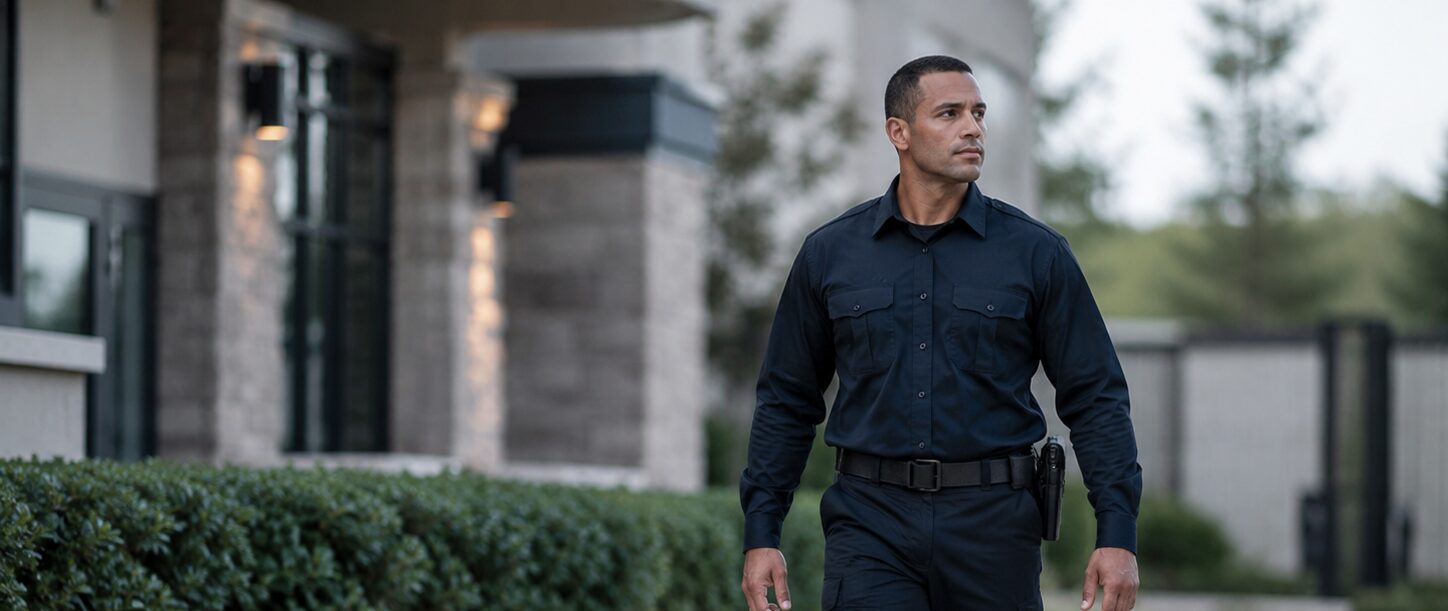
Facilities directors, executive pastors, security committees, and boards hire Capitol Shield Security for house of worship security across Northern Virginia and suburban Maryland. We cover service times, holidays, parking, and midweek activity, and we work with whatever volunteer team a congregation already has. Call (240) 957-0356 or ask us to price coverage.
A house of worship is a building whose entire purpose is being open, which makes it the hardest property type to secure without changing what it is. Every decision here trades against welcome, and a congregation that feels policed on a Sunday morning has lost something the security was supposed to protect.
The good news is that most of what works is undramatic: a person at the door who greets rather than screens, a lot that is watched during service, someone who notices the same car parked across the street three weeks running, and a plan everyone has actually read.
Service Times, and the Building Around Them
Most of a congregation's exposure sits in the hour on either side of a service. People arrive in a compressed window, the lot fills, doors are open by design, children go to classrooms in a separate part of the building, an offering is collected and counted, and then everyone leaves at once.
Coverage in that window is presence and awareness rather than screening. An officer visible at the main entrance, a second set of eyes on the lot, attention to the children's wing while it is occupied, and a plan for the count. The count is worth naming specifically: cash moving from a sanctuary to an office to a safe or a bank is the single most predictable financial exposure a congregation has, and it is often the least considered.
Midweek is quieter and different. Small groups, youth programs, food pantries, twelve-step meetings, and community rentals bring people into a mostly empty building, often after dark, often with a single staff member present. That is when a check-in and a walk-through matter more than a post.
Security officers are not a replacement for law enforcement, fire personnel, or emergency medical services.
High Holy Days, Ramadan, and Peak Attendance
Every tradition has dates when attendance multiplies and the building operates unlike any other week: Christmas and Easter, the High Holy Days, Ramadan and Eid, and the festivals and observances in between.
Those dates need a plan made weeks ahead rather than a call the day before. More people, more vehicles, overflow parking that spills onto neighborhood streets, unfamiliar faces including guests and visitors from other congregations, and often an evening or overnight schedule the building does not normally keep.
Some communities face elevated concern on exactly those dates, and that is a real consideration rather than a hypothetical one. What we bring is coverage sized to the actual concern, coordinated with the congregation's leadership and, where the congregation wants it, with the police agency with jurisdiction. What we do not bring is a posture that turns a holiday into a checkpoint.
We ask congregations to book these dates early. They fall on the same days for every congregation in a tradition, and a region has a finite number of officers.
Working With a Volunteer Safety Team
Many congregations already have one, and it is usually a mix of members with genuine relevant experience and members with enthusiasm. Both are assets and they need different things.
We work alongside a volunteer team rather than replacing it. Volunteers know the congregation, know who belongs, know which family is going through a divorce and which member is unwell, and that knowledge is not purchasable. What a professional officer adds is a person who is not a member, who can take an uncomfortable action without a relational cost, and who is trained and insured to do it.
The division that works is usually volunteers greeting and watching, with the officer handling anything that requires intervention, anything involving a stranger, and the parking. Written down before a service, that division prevents the most common failure, which is four people all assuming somebody else was watching the side door.
Access, Children's Areas, and Doors
Nearly every congregation has more doors than it can watch and a culture of propping them. That is the single most common finding when we walk a building.
The practical version of access control here is modest: reduce entry to one or two doors during services, check the rest on a walk rather than assuming they latched, control the children's wing so that pickup requires the right adult, and lock the offices and the sanctuary when the building is otherwise in use for something else.
Children's areas warrant specific attention because congregations that have not thought about it are often surprised by how open they are. Check-in and check-out procedures, a corridor that is watched, and a policy about who may collect a child are worth more than any hardware.
None of this requires the building to feel like a secured facility. It requires somebody to be responsible for it, which is usually the gap.
Grant Funding and Getting the Most From a Small Budget
The federal Nonprofit Security Grant Program is worth knowing about, because it is the reason many congregations can afford coverage at all. It is administered through state emergency management agencies, and contracted security personnel costs have been an allowable expense, unlike equipment supporting contracted security.
Rules, award ceilings, and deadlines change year to year, so confirm current-year terms with the emergency management agency for your jurisdiction rather than relying on a summary here. We are happy to provide the documentation an application needs, and we will tell you plainly that we are a vendor rather than a grant consultant.
Where budget is tight, the highest-value spend is usually the service window and the peak dates rather than continuous coverage. Where a congregation wants presence across a week, mobile patrol services covering the property on randomized passes costs a fraction of a post.
A Record for the Board, Not a Show of Force
Congregational leadership needs to be able to answer members and insurers about what is actually in place, and impressions do not survive that conversation.
Officers log checkpoints as they walk them, note conditions such as doors found unsecured or a vehicle that keeps appearing, and file reports the same day. GPS verification confirms a walk of the building covered the building. Reports describe property and observed behavior rather than identifying members of the congregation.
For a board that record supports the decisions that follow: whether the side entrance needs to be locked during services, whether the lot needs a second officer on holidays, whether the concern raised at a members' meeting shows up in the log. It also supports an insurance conversation, and for congregations pursuing grant funding it is the kind of documentation that makes a renewal application straightforward.
How We Cover Houses of Worship
- Coverage built around service times, midweek programs, and peak observances
- A presence that greets rather than screens, because welcome is the point of the building
- Support for the offering count, the most predictable financial exposure a congregation has
- A written division of roles with your volunteer safety team, agreed before a service
- Children's area access reviewed as part of the walkthrough, not as an afterthought
- Documentation suitable for an insurer or a grant renewal application
- Honest budgeting: peak dates and service windows before continuous coverage
House of Worship Coverage Questions
Not if the assignment is written properly, and that is the first thing we talk about. The default posture is presence and awareness rather than screening: someone at the main entrance who greets people, someone watching the lot, and someone checking the doors nobody else is checking. Congregations that want a lower-profile posture can have one, and we would rather adjust the presentation than have coverage that works against what the building is for.
Yes, and that is usually the better arrangement. Volunteers know the congregation in a way no outside officer can, and that knowledge catches things procedure never will. What an officer adds is someone who is not a member, who can take an uncomfortable action without a relational cost, and who is trained and insured for it. We write the division of roles down before the first service so nobody is assuming somebody else has the side door.
The Nonprofit Security Grant Program has allowed contracted security personnel costs, though not equipment supporting contracted security, and it is administered through state emergency management agencies. Ceilings, rules, and deadlines change year to year, so confirm current-year terms with the agency for your jurisdiction. We provide the documentation an application needs, and we will be clear that we are a vendor rather than a grant consultant.
Related Security Services
School and Campus Security
K-12, charter, and university campuses with supplemental and event-day coverage.
ExploreMobile Patrol and Alarm Response
Marked-vehicle patrol routes and after-hours alarm response across multiple sites.
ExploreUnarmed Security Guards
Uniformed unarmed officers for access control, lobby posts, and visible deterrence.
ExploreHouse of Worship Security Across the DC Metro Area
We provide house of worship security throughout the Washington DC Metro Area. Explore coverage by city.
Tysons
Houses of Worship security and full guard coverage in Tysons.
View locationArlington
Houses of Worship security and full guard coverage in Arlington.
View locationAlexandria
Houses of Worship security and full guard coverage in Alexandria.
View locationGreenbelt
Houses of Worship security and full guard coverage in Greenbelt.
View locationRockville
Houses of Worship security and full guard coverage in Rockville.
View locationSilver Spring
Houses of Worship security and full guard coverage in Silver Spring.
View locationWe are hiring licensed security guards across the DC metro area for armed, unarmed, and fire watch posts.
Discuss Coverage for Your Congregation
Tell us about your property and a dedicated security coordinator will recommend the right coverage.