
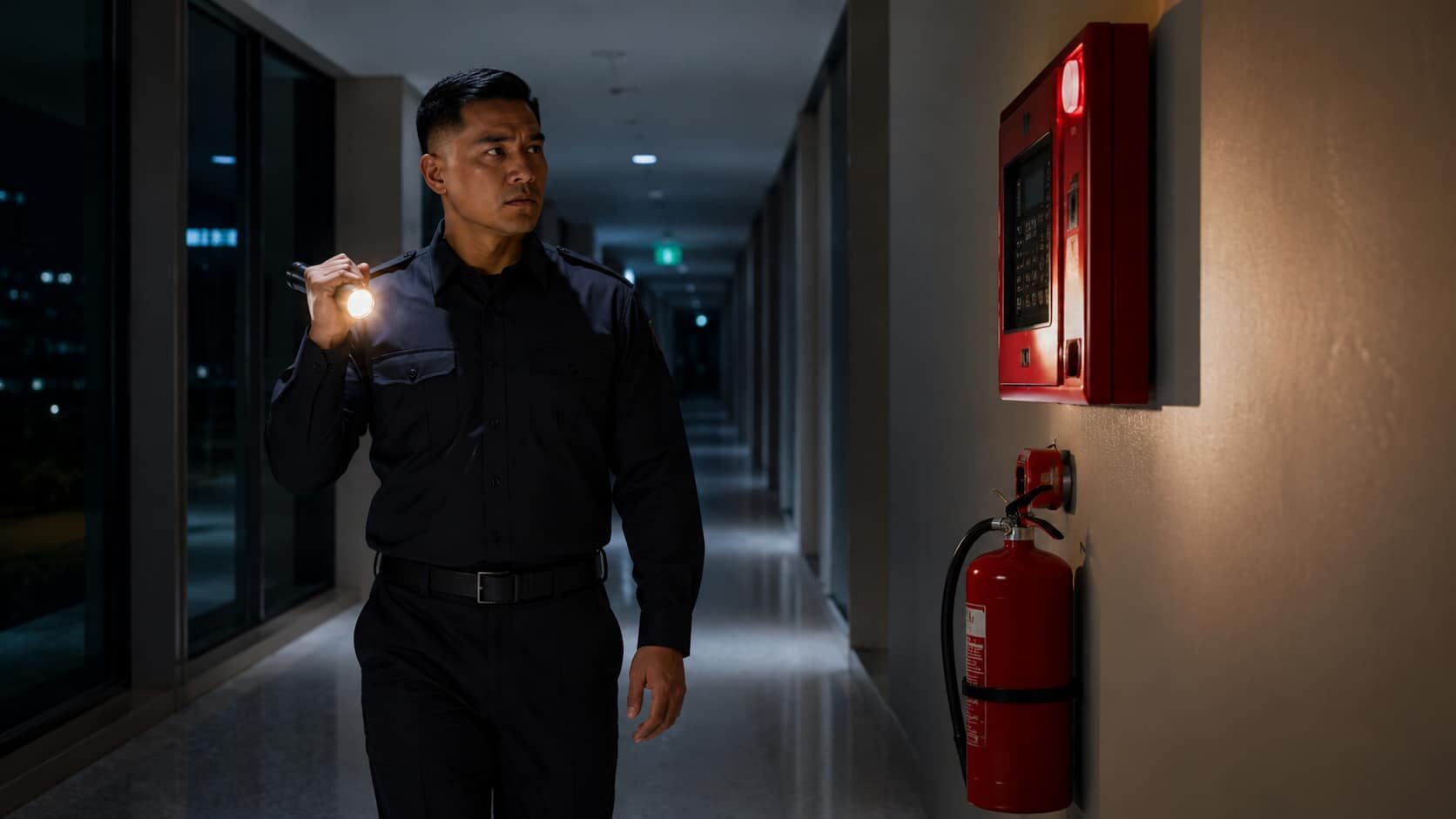
Property managers, general contractors, and building engineers hire Capitol Shield Security for fire watch coverage when a system goes down and the building has to stay open. We staff unarmed officers on documented routes across Northern Virginia and suburban Maryland, coordinate with the building engineer and the authority having jurisdiction, and hand back the log the fire marshal will ask to see. Call (240) 957-0356 or request a fire watch quote online.
Fire watch is the one security service nobody chooses. It arrives as a phone call from an engineer, a sprinkler contractor, or an inspector, and it usually arrives with hours of notice rather than days. The building either posts a watch or it stops operating.
That is why we treat it as a dispatch problem before it is a staffing problem. The first question on the call is what is impaired, when it went down, and what the authority having jurisdiction has told you. The second is what your window looks like. If we cannot cover it, we say so on that call rather than an hour later.
When a Fire Watch Is Required, and Who Decides
Two standards set the thresholds most buildings in this region run into. NFPA 101 addresses fire alarm systems and NFPA 25 addresses water-based fire protection. A fire alarm out of service for more than four hours in any twenty-four, or sprinklers out for more than ten in any twenty-four, obligates the building to post a watch or evacuate the affected area.
The thresholds are a floor, not the whole answer. The authority having jurisdiction can impose a shorter clock, require a specific patrol interval, require a particular log format, or require notification before the impairment starts rather than after. Jurisdictions across the region do not all handle this the same way, and the fire marshal reviewing your log is the one whose expectations matter.
Impairments come from ordinary work. Annual inspection and testing. A sprinkler main drained for a tenant fit-out. A panel replacement that runs long. Water damage to a riser. A renovation that cuts devices out of a zone. Almost none of it is an emergency, and all of it starts a clock.
What we need from you on the call is short: what is down, when it went down, whether the impairment is partial or building-wide, what the authority having jurisdiction has already said, and who the on-site contact is. We will ask about the building rather than about the contract.
What an Officer Does on a Fire Watch Route
A fire watch officer walks the building on a defined route at a fixed interval, and the route is built around the impairment rather than around the floor plan. If a single zone is out, the route weights that zone. If the whole system is down, the route covers every occupied area and every space where a fire could start unobserved.
On each pass the officer checks the specific hazard named in the impairment notice, looks for smoke, heat, and unusual odor, verifies that exits and egress paths are clear, confirms that fire doors are closed and not chocked, and checks any hot work area against its permit. Where a contractor is cutting or welding, the officer knows the permit hours and stays with the area after work stops for as long as the permit requires.
The officer also knows exactly what to do if something is found, because that is the part of the job the standard actually turns on. Notify occupants, call the fire department, and notify the building contact, in that order, from a phone the officer is carrying rather than one on a wall inside the building.
Fire watch is unarmed work by design. It requires no armed credential, and posting an armed officer on a fire watch route would be a mismatch of tools to the task.
Security officers are not a replacement for law enforcement, fire personnel, or emergency medical services.
Buildings That Need Fire Watch Most Often in This Region
Fire watch demand tracks the age and density of the building stock, and this region has a lot of both. Older high-rise office and hotel inventory generates the most impairments, because retrofitted protection in a building that predates the current standard fails more often than a system installed last year. Hospitals, laboratories, and licensed care facilities generate steady work for a different reason: they are heavily systemed and heavily regulated, so they test more.
Hotels sit in a category of their own. A hotel testing its systems has guests asleep on every floor and a life safety obligation that does not pause for the test, so the watch has to cover corridors and stairwells rather than sit at a desk. Mid-rise residential is similar, with the added problem that residents will chock a stair door open and undo half the compartmentation the building relies on.
Newer construction generates the least fire watch work, which is worth saying plainly. A building finished in the last few years with a working, monitored system will go a long time without needing a watch. Where it does come up in new stock, it is usually a building under commissioning or fit-out rather than one in normal operation.
Getting an Officer On Site the Same Day
Fire watch is booked on short notice or it is not useful, and we answer that honestly rather than with a slogan. Coverage may be available within one hour depending on location, guard availability, and assignment requirements. What that depends on is where the building is, what the window looks like, and how many officers the interval requires.
A single officer covers a single building on a single route. A large floor plate, a wide interval requirement, or a building with separated occupancies can require two, and we would rather tell you that before the shift than staff it thin and have the log show gaps.
We hold fire watch assignments open until the impairment clears rather than booking them in fixed blocks, because a sprinkler contractor's estimate and a sprinkler contractor's actual finish time are different numbers. When the system is restored and the authority having jurisdiction releases the watch, coverage ends that shift and the final log goes to your contact.
If the same building keeps generating impairments, that is a maintenance conversation rather than a security one, and we will say so.
Fire Watch and the Rest of Your Coverage
Most buildings that call us for a fire watch are not otherwise staffed, and there is no reason a single impairment should turn into a standing contract. When the watch ends, it ends.
Where it does make sense to keep something in place, it is usually smaller than what people expect. A property that has now had three impairments in a year often does better with mobile patrol services covering closing checks and after-hours passes than with a dedicated post. A building in the middle of a long fit-out sometimes wants construction site security for the work area while the occupied side stays as it was.
Officers who have worked a fire watch in your building already know its stairwells, its riser closets, its roof access, and which doors do not latch. That knowledge is worth something if you later need office building security or an overnight post, and it is why the post orders for a follow-on assignment are usually written from real observations rather than a walkthrough.
The Log Is the Deliverable
Everything above produces one artifact: a timestamped record of every pass, and that record is what the fire marshal reviews. Our officers mark each checkpoint as they reach it, note the condition of the impaired system and the area around it, photograph anything worth a second look, and close the report before leaving the site.
GPS verification confirms that a checkpoint on the report is one the officer physically stood at. That matters more on a fire watch than on any other assignment, because a log with even intervals and no verification behind it is exactly what an inspector is trained to be skeptical of.
You receive the log for each shift rather than a summary at the end. If the impairment runs a week, you have seven days of records as they happen, which is what you need if the authority having jurisdiction asks for them mid-impairment rather than after.
What You Get From a Capitol Shield Fire Watch
- Unarmed officers briefed on the specific impairment, not a generic patrol
- Route and interval built around the affected zone and the building's occupancy
- Timestamped, GPS-verified log delivered every shift, not at the end
- Hot work permit hours tracked and covered through the required watch period
- Direct coordination with your building engineer and the authority having jurisdiction
- Coverage held open until the system is restored and the watch is released
- A straight answer on the first call about whether we can staff your window
Fire Watch Questions
Coverage may be available within one hour depending on location, guard availability, and assignment requirements. What drives it is where the building sits, how long your window runs, and whether the interval and floor plate need one officer or two. We will tell you on the first call whether we can cover it, because a maybe is worse than a no when you are on the clock with an inspector.
Every pass is recorded with a time, a location, the condition of the impaired system, and a note on anything found, with photographs where they help. GPS verification confirms the officer reached each checkpoint. The log is written for the authority having jurisdiction, so it is delivered per shift rather than compiled at the end, and it is yours to hand over the moment an inspector asks.
No. Fire watch is procedural, unarmed work: a defined route, a fixed interval, checks on a named hazard, and a documented log. An armed credential adds nothing to that task. We staff armed officers where a property's risk profile genuinely calls for it, and a fire watch is not one of those situations.
Related Security Services
Mobile Patrol and Alarm Response
Marked-vehicle patrol routes and after-hours alarm response across multiple sites.
ExploreConstruction Site Security
Overnight and weekend coverage, gate control, and equipment and material theft prevention.
ExploreOffice Building Security
Lobby and front-desk posts, visitor management, and after-hours access control.
ExploreFire Watch Security Across the DC Metro Area
We provide fire watch security throughout the Washington DC Metro Area. Explore coverage by city.
Tysons
Fire Watch security and full guard coverage in Tysons.
View locationArlington
Fire Watch security and full guard coverage in Arlington.
View locationAlexandria
Fire Watch security and full guard coverage in Alexandria.
View locationGreenbelt
Fire Watch security and full guard coverage in Greenbelt.
View locationRockville
Fire Watch security and full guard coverage in Rockville.
View locationSilver Spring
Fire Watch security and full guard coverage in Silver Spring.
View locationWe are hiring licensed security guards across the DC metro area for armed, unarmed, and fire watch posts.
Request Fire Watch Coverage
Tell us about your property and a dedicated security coordinator will recommend the right coverage.