
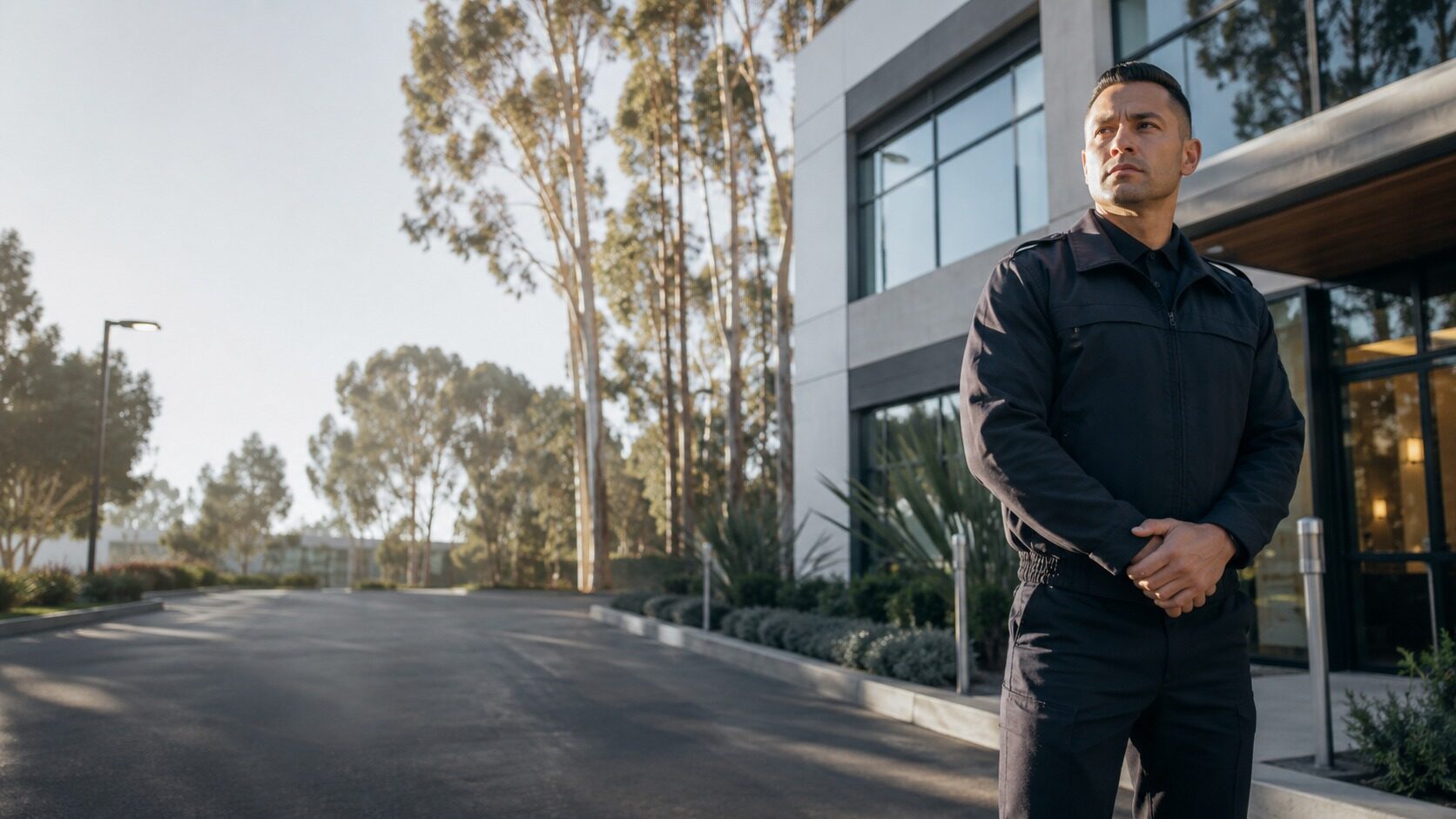
Twinbrook landlords, general contractors, and property managers hire Capitol Shield Security for licensed officers, construction and fit-out coverage, mobile patrols, and fire watch, staffed and dispatched 24/7. We cover laboratory conversions inside occupied buildings, the office floors underneath them, redevelopment parcels in active work, and the parking structures serving all of it, backed by Maryland State Police license #26PLU-SG80123. Security coverage in Twinbrook is coordinated through our Rockville office two miles north, so staffing, supervision, and reporting stay local. Call (240) 957-0356 or request a free Twinbrook security quote online.
Twinbrook is turning into a laboratory district out of office and light industrial stock, and it is doing it without emptying first. That is the fact that shapes the work here.
Converting a building to laboratory use is not a fit-out in the ordinary sense. It means new mechanical plant, roof penetrations, gas and chemical storage, waste routes, and power that the building was never designed to carry, installed over months by trades who need the freight car, the roof, the risers, and the loading area. Meanwhile the existing tenants are still paying rent and still expecting a normal working day. Almost every problem we are called about in Twinbrook lives in that overlap.
Two Populations, One Building, Different Rules
The first thing worth stating is that a building in conversion has two sets of people in it who are governed by entirely different arrangements.
A tenant's staff are on badges, on a lease, and on a schedule the property manager knows. A fit-out crew is on a contractor's roster, arrives in numbers that change daily, brings subcontractors nobody circulated in advance, and needs access to parts of the building tenants never see. Neither group is a problem. The gap between the two systems is.
That gap shows up in ordinary ways. A propped stair door held for a cable pull that stays propped after the crew leaves. A freight car released to a trade for the afternoon and never returned to control. A roof hatch opened at nine and closed at six by somebody who assumed somebody else had checked it. Nothing in that list is theft, and all of it is how a building stops being closed.
Post orders on these accounts are written jointly, with the property manager and the general contractor in the same conversation, so the officer holds one set of instructions rather than refereeing two. Where a landlord will not convene that conversation we will say plainly that the coverage will be weaker for it.
Fit-Out Coverage Inside an Occupied Building
Construction site security in a conversion has no fence, no gate, and no laydown yard, so the shape of it is different from a ground-up job in every respect except the hours.
What we cover instead is access and movement. Trade crews checked in against the schedule the superintendent gives us, including the subcontractors who turn up as a name on somebody's phone. Material and tool storage inside the building treated as named checkpoints and photographed each pass. Roof access, mechanical rooms, and riser closets checked and recorded rather than assumed. The freight car and the service corridor under control during active periods. And an end-of-day walk that verifies the openings created by the day's work are closed, because a wall opened for a duct run at two is a hole into an occupied floor at seven.
The overnight and weekend hours carry most of the loss risk. Copper, wire, tools, and equipment staged for installation leave a building through the same doors that let them in, and a conversion stages a great deal of expensive material for weeks at a time. On most of these jobs the right coverage is overnight and weekend passes with the storage areas photographed on every visit rather than a continuous post. On a job with several trades running at once and material on the ground, that judgment goes the other way, and we say which one you have after the walk-through rather than in a proposal.
What Arrives Before the Tenant Does
Laboratory conversions produce a receiving problem that ordinary construction never generates, and it starts well before anybody is doing science in the building.
Gas cylinders, chemical stock, cold units, and instrumentation begin arriving while the space is still a job site. They come on a manufacturer's schedule rather than the site's, into a building with no lab staff yet, and they get signed for by whoever is nearest the door. A pallet of cylinders standing in a corridor over a weekend is a different object from a pallet of drywall, and the crews around it frequently do not know that.
What we do about it is narrow and it is written down. Deliveries are checked against a list the tenant and the contractor agree in advance. Anything arriving that is not on the list is held at the receiving point and escalated rather than accepted into the building. Storage locations for received material are named checkpoints, photographed each pass. Our officers do not sign for freight, do not adjudicate a discrepancy, and do not decide what is safe to store where, and any vendor telling you otherwise is offering to carry a liability they cannot hold.
Security officers are not a replacement for law enforcement, fire personnel, or emergency medical services. We maintain professional working relationships and clear communication with local police and fire agencies, and we do not guarantee their response times.
The Office Floors Underneath It All
The existing office tenancy in these buildings signed a lease for an office building, and the reasonable expectation that goes with that does not pause for a conversion.
Office building security here is therefore partly about protecting a normal working day from the work going on above it. A staffed lobby that verifies visitors against an expected list and can tell a contractor from a client. Badge and door discipline that survives a period when doors are being held open for legitimate reasons several times a day. Dock and delivery supervision, which in a conversion is carrying twice its usual volume. After-hours access confirmed as authorized rather than merely successful, with a separate written arrangement for contractor after-hours work so the two never get confused.
Tenant complaints in a converting building are also worth taking seriously as data rather than as noise. A tenant who reports an unfamiliar person on their floor at eight in the evening is usually reporting a real gap in the contractor access arrangement, and the fix is a procedure rather than a posted officer.
Fire Watch That Runs Through a Conversion
The standard belongs to NFPA 101 and NFPA 25: beyond four hours of fire alarm outage inside a twenty-four hour period, or ten hours without sprinklers, a building is under a posted watch or it is not occupied. The authority having jurisdiction issues the order, generally at short notice.
Conversion work produces these more reliably than anything else in this market, and it produces the long ones. Sprinkler reconfiguration for a new lab layout, detection moved for new walls, and mechanical work touching the fire alarm interface all take systems down, and a phased conversion takes them down repeatedly over months rather than once. A watch here is frequently not a weekend job, it is a standing arrangement that starts and stops with the phases.
The building underneath is occupied, which decides how the watch is run. Fire watch security in that setting means a circuit that covers the impaired area and the occupied floors under it, an interval held to the clock rather than to the pace of the walk, direct attention to whatever the impairment names, an entry stamped at the end of every lap, and an officer trained to pull the alarm and make the call rather than investigate. Where an impairment recurs by phase we keep a fixed rotation of officers who already know the building rather than sending whoever is free.
Coverage may be available within one hour depending on location, guard availability, and assignment requirements.
Parking Structures and the Evening Gap
Structured parking here serves office tenants during the day and contractor vehicles well outside those hours, which produces a long window when a deck is neither full nor empty and nobody is responsible for it.
Parking lot security here is foot coverage at intervals that vary rather than a camera at an entrance, weighted to the early evening when office tenants leave and to the later hours when trade crews finish. Vehicle entries and tool theft from contractor vehicles cluster on the levels furthest from a lit lobby, and a contractor's van left overnight with the day's tools in it is a more attractive target than anything inside the building.
A Record With a Landlord and a Contractor In It
Every Twinbrook account gets time-stamped, photo-verified reporting. Officers stamp checkpoints as they reach them, photograph anything a written line would not settle, and close incidents before handing over. Positions carry GPS verification, so a landlord and a contractor are reading the same verifiable set of facts rather than two accounts of an evening.
That shared reading is most of the point here. In a conversion the two parties paying attention have different interests, and when something goes wrong the first conversation is usually about whose people were where. A dated entry with a photograph settles that in one exchange, which is worth more than either party expects at the point they are signing.
The record also does routine work that saves money. End-of-day photographs of openings created by the day's work, storage areas, roof access, and riser closets give a superintendent a condition report every morning without anybody walking the building twice, and they give a landlord evidence when a tenant raises something a month later.
An Example Twinbrook Security Plan
A landlord converting two floors of an occupied office building to laboratory use called us after a tenant on a lower floor reported people in their suite after hours twice in a fortnight. Nothing was missing. The tenant was, reasonably, unsettled.
The walk-through found no forced entry and no failure of the base building system. What it found was a stair door on the conversion floors that had been chocked open for a cable pull three weeks earlier and never released, and a freight car that had been put on independent service for the trades in the morning and left there overnight most days. Between the two, anybody on the job could reach any floor without a badge, and several of them had, mostly by accident and mostly looking for a bathroom.
We put an officer on the building across the late afternoon and evening band, when the trades were finishing and the office tenants were leaving, rather than the overnight post the landlord had asked us to price. The stair doors, the freight car status, and the roof hatch became named checkpoints photographed at the start and end of every shift. The general contractor and the property manager agreed one set of after-hours access rules and we held them.
The after-hours reports from the tenant stopped inside two weeks. The finding the landlord kept was smaller and more useful: the shift-end photograph of the freight car status turned an argument that had been running for a month into a two-line procedure.
This example is anonymized, but the approach is standard: review the risk, write the plan, document the work, and refine it over time.
Security Services Available in Twinbrook
Every service includes trained guards, site-specific post orders, and photo-verified patrol reporting.
Fire Watch Security
Code-mandated coverage when a fire alarm or sprinkler system is out of service.
ExploreMobile Patrol and Alarm Response
Marked-vehicle patrol routes and after-hours alarm response across multiple sites.
ExploreArmed Security Guards
Licensed armed officers for higher-risk posts and cash- or asset-sensitive sites.
ExploreUnarmed Security Guards
Uniformed unarmed officers for access control, lobby posts, and visible deterrence.
ExploreConstruction Site Security
Overnight and weekend coverage, gate control, and equipment and material theft prevention.
ExploreCommercial and Retail Security
Shopping centers, grocery, and mixed-use retail with access control and loss prevention support.
ExploreOffice Building Security
Lobby and front-desk posts, visitor management, and after-hours access control.
ExploreApartment and Multifamily Security
Apartment communities, condo associations, and HOAs with patrol and parking enforcement support.
ExploreWarehouse Security
Overnight patrols, dock monitoring, and documented checks for warehouse and cold storage.
ExploreDistribution Yard Security
Truck gate control, trailer checks, and yard patrols for distribution and logistics sites.
ExploreParking Lot and Garage Security
Garage and surface-lot patrols, vehicle break-in deterrence, and escort support.
ExploreHospitality and Event Security
Hotels, conference and convention venues, stadiums, festivals, and private events.
ExploreHealthcare and Senior Living Security
Hospitals, medical office buildings, behavioral health, assisted living, and memory care.
ExploreSchool and Campus Security
K-12, charter, and university campuses with supplemental and event-day coverage.
ExploreHouse of Worship Security
Churches, synagogues, and mosques, including coverage funded through the Nonprofit Security Grant Program.
ExploreGovernment and Institutional Security
County seats, courthouses, libraries, transit facilities, and federal and municipal campuses.
ExplorePart of the Rockville Area We Serve
Rockville
Security guard company in Rockville, MD, for hospital and laboratory property, county institutional buildings, and I-270 patrol routes.
View locationNorth Bethesda
Security guards in North Bethesda, MD, for Pike & Rose hotels, shared garages, and the apartment floors above the retail.
View locationBethesda
Security guards in Bethesda, MD, for the private clinical and Class A office property around NIH, Walter Reed, and Suburban Hospital.
View locationShady Grove
Security guard services in Shady Grove, MD, for the clinical ring around Adventist Shady Grove and the Universities at Shady Grove.
View locationTwinbrook Security Questions
Both parties, in the same conversation. A contractor knows the trade schedule and the access it needs, and a property manager knows the tenants and the base building. If the officer holds two sets of instructions they will end up refereeing rather than working, so we sit down with both before the first shift and produce one document. Where a landlord will not convene that, we will still take the work and we will tell you the coverage is weaker for it.
We check them against a list your tenant and contractor agree in advance, hold anything not on that list at the receiving point, escalate it, and treat the storage locations as photographed checkpoints. What we do not do is sign for freight, adjudicate a discrepancy, or decide what may be stored where. Those decisions belong with your people, and a security vendor who accepts them is taking on something they cannot carry.
On a phased conversion, usually yes. Sprinkler reconfiguration, detection moves, and mechanical work at the fire alarm interface each take systems down, and a job running in phases takes them down repeatedly across months. We would rather set that up as a standing arrangement with a fixed rotation of officers who already know the building than answer each impairment as a fresh emergency.
On most conversions here, passes do. Overnight and weekend visits with the material and tool storage photographed each time cover the hours that carry the loss risk, at a fraction of a continuous post. Where several trades are running at once with a lot of material on the ground, a posted officer is the right call, and we will tell you which one you have after walking the job rather than before.
We are hiring licensed security guards in Twinbrook for armed, unarmed, and fire watch posts.
Schedule a Twinbrook Security Walkthrough
Tell us about your property and a dedicated security coordinator will recommend the right coverage.