
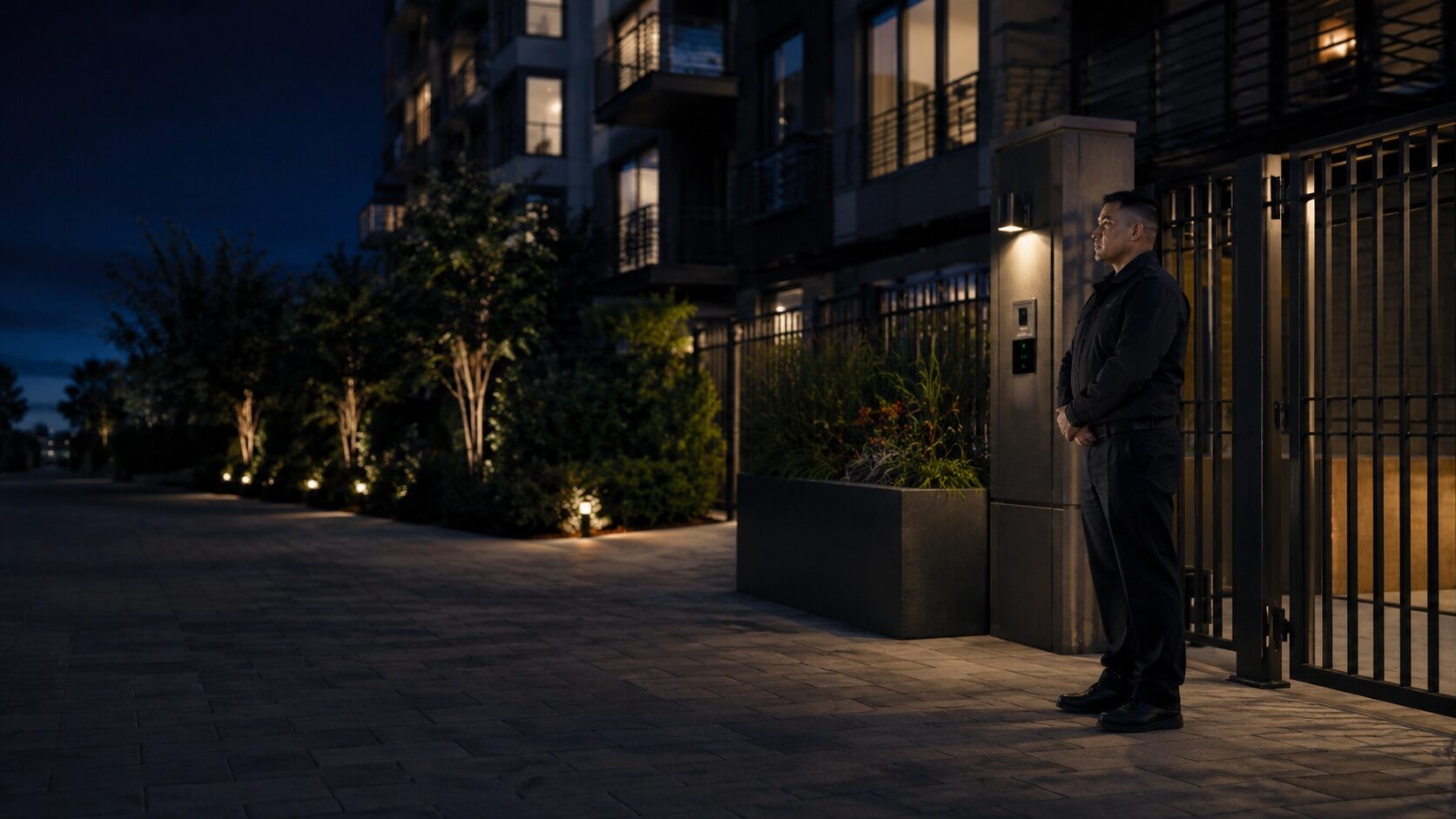
Regional managers, on-site property managers, and association boards hire Capitol Shield Security for apartment building security across Northern Virginia and suburban Maryland. We staff access points, patrol amenity spaces and parking, enforce posted hours, and document what happens. Call (240) 957-0356 or ask us to price coverage for your community.
Residential coverage differs from every other property type in one way that changes everything: the people on the property live there. They are not visitors passing through a lobby or employees leaving at five. They will see the same officer for months, they will form an opinion about whether the coverage is helping, and they will tell the board.
That makes consistency the whole product. A residential post that is warm, visible, and predictable in the right ways builds something a commercial post never needs to. A residential post that is inconsistent generates complaints faster than the problem it was hired to solve.
New Product and Older Stock Are Different Jobs
A recently built controlled-access building and a nineteen-sixties garden-apartment community have almost nothing in common operationally, and pricing them the same way is how coverage ends up mismatched.
Newer buildings usually arrive with controlled entries, cameras, a package room, and amenity spaces on card access. The hardware exists; the problem is that hardware assumes people follow it. What actually happens is tailgating at the garage gate, a gym door propped in the evening, package room access shared between residents, a rooftop or clubroom used after posted hours, and a fire stair used as a shortcut. The officer's job is making the systems mean something.
Older garden-apartment communities are open by design. Multiple building entrances, surface parking, walkable ground between buildings, and no meaningful perimeter. There is no hardware to enforce, so the deterrent is presence, and it works because residents come to recognize the officer and strangers become visible.
This region carries a great deal of the second kind, particularly the mid-century garden stock managed by companies that actually buy patrol coverage rather than substituting a concierge. That product is where residential security is most useful and most often underserved.
The Complaint Log Is the Scope Document
The most reliable way to build residential post orders is to read six months of resident complaints and maintenance tickets. Whatever a board believes the problem is, the complaint log says what residents are actually experiencing.
If the log says vehicle break-ins, patrols route through parking on a schedule that does not repeat, weighted to the hours the incidents actually occurred. If it says noise around the pool after ten, the post orders name the amenity, name the hours, and say the officer enforces them. If it says people are sleeping in the laundry rooms, the officer checks the laundry rooms.
That sounds obvious. It is uncommon, because most residential coverage is written from a walkthrough and a conversation with a manager rather than from the record of what residents have reported.
We ask for the complaint log before quoting, and we revisit it. A community that has had a post for four months has a different complaint pattern than it had on day one, and the orders should follow it.
Access, Amenities, and the Enforcement Problem
Enforcement in a residential setting is where officers get into trouble, because the person being asked to leave the pool at eleven pays the rent that pays the officer.
The way through it is that the officer enforces posted rules, not opinions. If the pool closes at ten, that is a posted rule and enforcing it is not a judgment call. If a guest policy limits visitors after a certain hour, the policy is the authority and the officer is applying it. Anything not posted is a conversation with management rather than an instruction to an officer.
Access work is the other half. Verifying that a contractor has a work order before letting them into a building. Watching a garage gate for the car that follows the resident through. Confirming that vacant units are actually secured, particularly during turnover season when a community can have dozens of empty apartments with keys in circulation.
Security officers are not a replacement for law enforcement, fire personnel, or emergency medical services. Where a resident dispute becomes a criminal matter, the officer documents it and hands it to the police agency with jurisdiction rather than mediating it.
Post, Route, or Both
Very few communities need a full-time post, and we would rather say so than sell one. The common shapes are a short evening post covering the hours incidents actually happen, a patrol route covering several communities in a portfolio, or a combination of the two.
For a management company with multiple properties in the same submarket, mobile patrol services almost always beat a post per property. One officer running four communities on randomized timing produces more useful coverage per dollar than four officers standing at four leasing offices, and each property still gets a logged, documented presence.
Where a community has an acute problem, a lease-up with contractors still on site, a run of break-ins, an ongoing dispute, a temporary post for a defined period is usually the right answer, with a written end date rather than an open contract.
Armed officers are not the answer here. A residential community with an armed officer walking past a playground has changed how the property reads to its own residents, and almost never in the direction the owner wanted.
Working With the Site Team
The on-site manager and the maintenance lead know more about the property than any incident report will show, and they are the officer's most useful relationship. Which building has the recurring problem. Which unit is in eviction. Which resident calls about everything. Which back gate has been broken since spring.
We put officers on the same page as the site team deliberately: a standing check-in at shift start, and a written handoff so the next officer inherits the context. Boards get a summary they can actually read at a monthly meeting rather than a stack of logs.
What the Board Sees
Residential coverage is judged at board meetings, and a board that cannot see what it is buying will eventually stop buying it.
Officers mark checkpoints as they reach them, photograph what is worth documenting, and file incident reports before going off shift. GPS verification confirms the officer reached each point, so a route that shows all six buildings was a route that visited all six buildings.
What that gives a manager is the ability to answer a resident precisely. Whether the lot was patrolled on the night a car was hit. Whether the pool was checked at close for the last three weeks. Whether the complaints from one building are a pattern or a single loud resident. Those are the conversations residential management actually has, and having a dated record changes every one of them.
How We Cover Residential Property
- Post orders built from six months of your resident complaints, not from a walkthrough alone
- Coverage weighted to the hours incidents actually happened at your community
- Consistent officers, so residents come to recognize who belongs
- Enforcement limited to posted rules, which keeps officers out of judgment calls
- Vacant unit and turnover checks during the seasons that need them
- Portfolio routing across multiple communities where that beats a post per property
- A record a board can read, with dated answers to resident questions
Multifamily Coverage Questions
For most portfolios, a route. One officer running several communities on randomized timing produces more coverage per dollar than a post at each leasing office, and every property still gets logged, documented passes. A dedicated post earns its place when a single community has an acute problem, a staffed entry, or an exposure that sits continuously rather than in a window. Where we think a route is enough, we will say so.
They enforce posted rules. Pool hours, amenity hours, guest policies, and parking rules that are actually posted and actually in the lease are enforceable and we write them into the post orders by name. Anything not posted is a management conversation rather than an officer instruction, because an officer applying an unwritten rule to a resident is how a security program generates the complaints it was hired to reduce.
We do not recommend it and we will tell you why before quoting it. An armed officer changes how residents read their own community, and the incidents residential properties actually have, trespassing, noise, vehicle break-ins, disputes, are not addressed by a firearm. Where a community faces a specific documented threat, that is a different conversation and a time-limited one.
Related Security Services
Mobile Patrol and Alarm Response
Marked-vehicle patrol routes and after-hours alarm response across multiple sites.
ExploreParking Lot and Garage Security
Garage and surface-lot patrols, vehicle break-in deterrence, and escort support.
ExploreUnarmed Security Guards
Uniformed unarmed officers for access control, lobby posts, and visible deterrence.
ExploreApartment and Multifamily Security Across the DC Metro Area
We provide apartment and multifamily security throughout the Washington DC Metro Area. Explore coverage by city.
Tysons
Apartment and Multifamily security and full guard coverage in Tysons.
View locationArlington
Apartment and Multifamily security and full guard coverage in Arlington.
View locationAlexandria
Apartment and Multifamily security and full guard coverage in Alexandria.
View locationGreenbelt
Apartment and Multifamily security and full guard coverage in Greenbelt.
View locationRockville
Apartment and Multifamily security and full guard coverage in Rockville.
View locationSilver Spring
Apartment and Multifamily security and full guard coverage in Silver Spring.
View locationWe are hiring licensed security guards across the DC metro area for armed, unarmed, and fire watch posts.
Price Coverage for Your Community
Tell us about your property and a dedicated security coordinator will recommend the right coverage.