
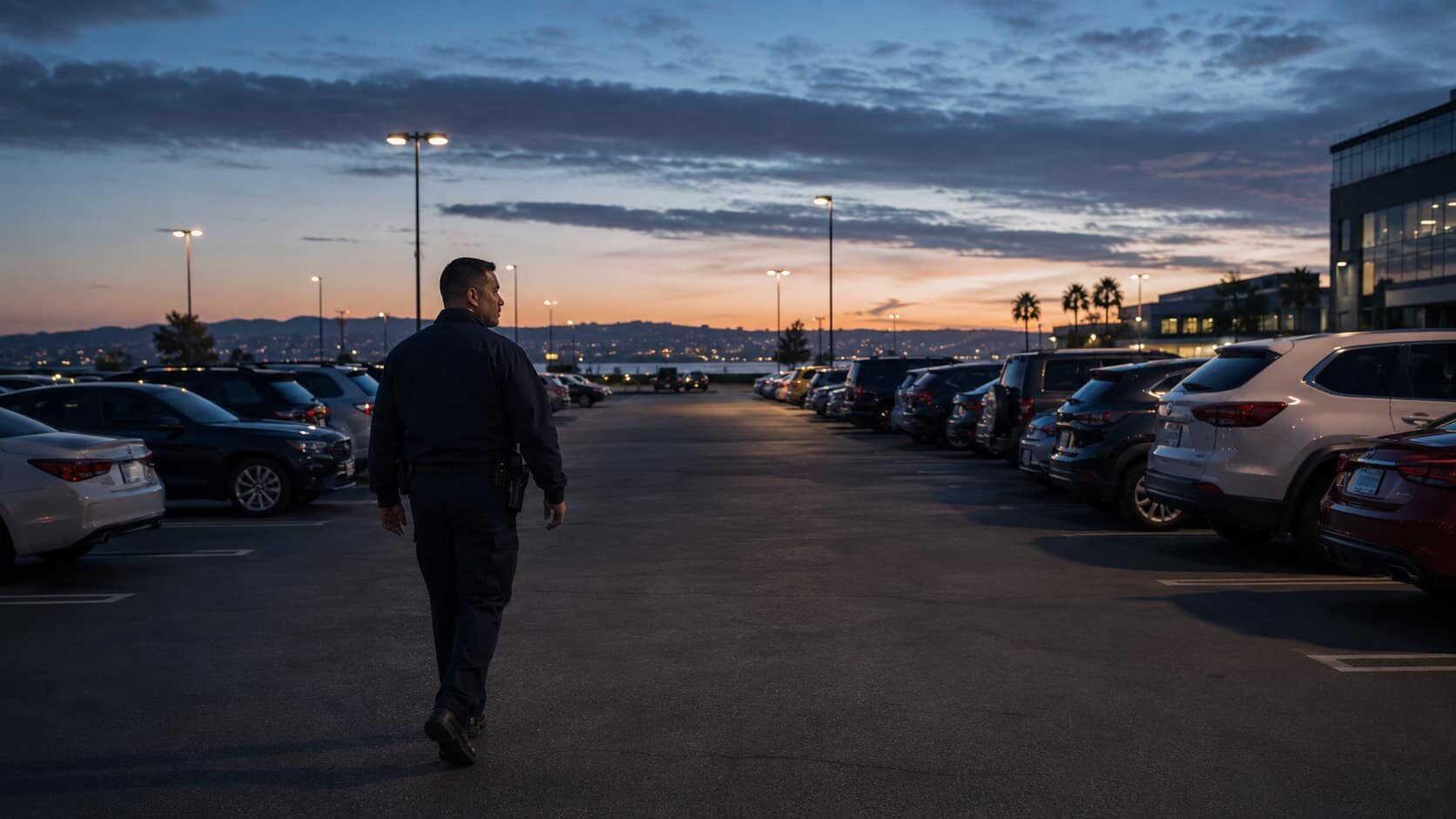
Property managers, garage operators, and facility teams hire Capitol Shield Security for parking lot security across Northern Virginia and suburban Maryland. We patrol structures and lots on foot, staff escort requests, and document every pass. Call (240) 957-0356 or ask us to price coverage for your parking.
Parking is where most commercial property loses money and most tenants form their opinion of whether a building is safe. It is also the part of a property that is almost always covered last, usually with a camera nobody watches and a light that has been out since spring.
The pattern is consistent across property types. A structure that is full and busy at midday feels fine. The same structure at eight at night, three-quarters empty, with a handful of people walking to isolated cars, is a different place. Coverage that is spread evenly across a day misses it entirely.
Structures and Surface Lots Fail Differently
A parking structure is an enclosed environment with poor sightlines, concrete that blocks radio and cell signal, stairwells that are isolated by design, and levels that empty at different rates. Its problems are proximity problems: somebody working a car two rows away is invisible from the ramp, and somebody waiting in a stairwell is invisible from anywhere.
A surface lot is the opposite. Long sightlines, easy entry from any edge, and a perimeter that is usually landscaping rather than fence. Its problems live at the margins: the row nearest the tree line, the corner nobody drives through, the section beyond the last light.
Coverage differs accordingly. A structure gets walked, level by level, including the stairwells and the elevator lobbies, because driving a ramp tells you almost nothing. A lot gets walked at its edges rather than its center, and the far rows get the attention the front rows do not need.
Both get covered on intervals that do not repeat. A patrol that arrives on the hour is a patrol whose schedule anyone can learn in a week.
What Actually Happens in Parking
Vehicle break-ins are the volume item and they are quick: a window, a bag, gone. Catalytic converter theft is the higher-value version and it takes a few minutes under a vehicle, which is why a truck or SUV parked at the far edge of a lot is the target rather than the sedan by the door.
Vehicles get damaged, occasionally deliberately and often by carts, delivery equipment, or another driver who did not leave a note. People sleep in vehicles in the corners of lots that never see traffic. Structures attract loitering in stairwells and on upper levels that are empty after five.
Then there is the category that matters most to tenants and residents even though it is the least frequent: confrontations, harassment, and the general experience of walking alone to a car in a space that feels unwatched. That is the one that shows up in a lease renewal conversation.
Security officers are not a replacement for law enforcement, fire personnel, or emergency medical services.
Escorts Are the Cheapest Thing You Can Offer
A standing escort request, publicized so people know it exists, is the highest-value item on most parking coverage plans and it costs almost nothing to add.
The mechanics are simple. Anyone who wants to be walked to their vehicle asks at the desk, or calls the number on the posted sign, and an officer walks with them. It takes a few minutes and it converts an anxious walk into an ordinary one.
Two things make it work. It has to be publicized, because an unadvertised escort service gets used by nobody. And it has to be genuinely available rather than technically available, which means the post orders account for the officer being away from the desk or off the route for a few minutes at a time.
Buildings that add escorts almost always find the request volume higher than expected, concentrated among the same evening staff who raised the concern in the first place.
Access Control, Gates, and Enforcement
Where a garage runs controlled access, most of the failures are the same handful. Tailgating through a gate behind a valid credential. A credential shared between people. A gate arm that has been broken long enough that everyone has stopped noticing. A visitor validation process that nobody enforces after five.
An officer at a gate during peak hours addresses the tailgating problem directly. Outside those hours, patrol coverage catches the doors and gates that are not doing what they were installed to do.
Enforcement is a boundary worth naming. Our officers document parking violations, unauthorized vehicles, and repeat offenders, and they support your enforcement process. They do not tow, boot, or issue citations. Where a vehicle blocks access, we coordinate with your towing provider rather than acting as one.
Where Parking Coverage Fits With Everything Else
Parking is almost never a standalone contract. It is usually a component of coverage for the property it serves, and structuring it that way costs less than buying it separately.
On a retail property it is part of commercial security guard services, weighted to peak evening hours. On an office property it sits inside office building security, with escorts run from the lobby desk. On a residential property it is part of apartment building security, weighted to the overnight when resident vehicles are parked and nobody is watching.
Standalone parking coverage does make sense for operators running structures as a business, for event and venue parking, and for a garage with a documented problem that its host property does not otherwise justify staffing. Where a property needs less than a post, mobile patrol services covering several lots on randomized passes usually fits better than a dedicated officer.
Logged by Level, Not by Loop
Parking coverage is the easiest place in the industry to claim work that did not happen, because nobody is watching a structure at eleven at night and a report that says patrolled is unfalsifiable.
Our officers mark a checkpoint on each level as they reach it, photograph conditions worth documenting, from a lighting outage to a vehicle that has not moved in a week, and file the shift report before going off duty. GPS verification means a report showing all six levels reflects an officer who was on all six levels.
That record is what answers the question that actually gets asked. A tenant whose car was broken into on Tuesday wants to know whether anyone was in that structure on Tuesday night, and a dated, level-by-level log answers it in a sentence. It also builds the case for the fixes that matter: eleven dated entries about the same dark corner is a lighting work order that finally gets written.
How We Cover Parking
- Structures walked level by level, including stairwells and elevator lobbies
- Surface lots covered at the edges and far rows, where the losses actually happen
- Coverage weighted to the hours a lot empties rather than spread across the day
- Randomized intervals, so the schedule cannot be learned
- Escorts on request, publicized so people actually use them
- A clear enforcement boundary: we document and support, we do not tow or cite
- Level-by-level, GPS-verified passes rather than a report that says patrolled
Parking Coverage Questions
On foot inside structures, always. Driving a ramp tells you very little: the sightlines that matter in a garage are down the rows and into the stairwells, and neither is visible from a moving vehicle. On large surface lots we use a combination, covering ground by vehicle and walking the far rows and perimeter edges where vehicles are actually worked. The post orders say which, by area.
Yes, and we recommend building it in. It is the least expensive item on most parking plans and it is the one tenants and residents notice. It works when it is publicized, so people know the option exists, and when the post orders account for the officer being away from the desk for a few minutes. Buildings that add escorts consistently find demand higher than they expected.
No. Officers document unauthorized vehicles, repeat offenders, and vehicles blocking access, with photographs and times, and they support whatever enforcement process you already run. Towing and citations stay with your towing provider and your management office. Where a vehicle is blocking an entrance or a fire lane, we contact your provider and document the whole sequence.
Related Security Services
Commercial and Retail Security
Shopping centers, grocery, and mixed-use retail with access control and loss prevention support.
ExploreOffice Building Security
Lobby and front-desk posts, visitor management, and after-hours access control.
ExploreMobile Patrol and Alarm Response
Marked-vehicle patrol routes and after-hours alarm response across multiple sites.
ExploreParking Lot and Garage Security Across the DC Metro Area
We provide parking lot and garage security throughout the Washington DC Metro Area. Explore coverage by city.
Tysons
Parking and Garages security and full guard coverage in Tysons.
View locationArlington
Parking and Garages security and full guard coverage in Arlington.
View locationAlexandria
Parking and Garages security and full guard coverage in Alexandria.
View locationGreenbelt
Parking and Garages security and full guard coverage in Greenbelt.
View locationRockville
Parking and Garages security and full guard coverage in Rockville.
View locationSilver Spring
Parking and Garages security and full guard coverage in Silver Spring.
View locationWe are hiring licensed security guards across the DC metro area for armed, unarmed, and fire watch posts.
Price Coverage for Your Parking
Tell us about your property and a dedicated security coordinator will recommend the right coverage.